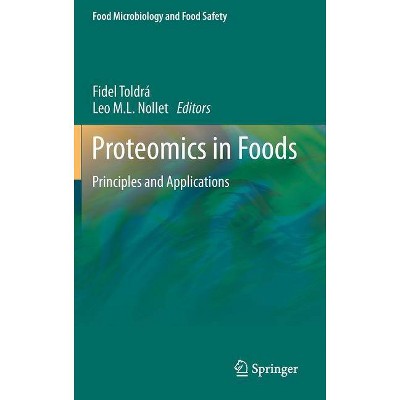
Proteomics in Foods - by Fidel Toldrá & Leo M L Nollet (Hardcover)
Similar Products





Products of same category from the store
All








Product info
<p/><br></br><p><b> About the Book </b></p></br></br>The book covers the principles of proteomics and details applications to foods, such as quality issues related with post-mortem processes in animal foods, identification of proteins, and safety issues like food authenticity and detection of animal species.<p/><br></br><p><b> Book Synopsis </b></p></br></br><p><i>Part I. Principles of Proteomics.- </i>1. Understanding the proteome. - 2. Extraction/fractionation techniques for proteins and peptides and Protein digestion.- 3. Primary separation: 2-D electrophoresis.- 4. Primary Separation: Chromatography.- 5. Mass spectrometry applications.- <i>Part II. Food Applications of Proteomics.- </i>6. Challenges and applications of protemics for analysis of changes in early postmortem meat.- 7. Application of proteomics for analysis of protein modifications in postmortem meat.- 8. Biological markers for meat tenderness of the three main French beef breeds using 2-DE and MS approach.- 9. Dry-cured ham.- 10. Evaluation of fish quality and safety by proteomics techniques.- 11. Farmed and Wild fish.- 12. Fish Authentication.- 13. Proteomics in Milk and Milk Processing.- 14. Cheese processing.- 15. Lactic acid bacteria in fermented foods.- 16. Wine quality.- 17. Eggs.- 18. Fruits and vegetables.- 19. Wheat grain proteomics for the food industry.- 20. Proteomics and applications to food science in rice.- 21. Beer proteomics.- 22. Nutritionally relevant proteins.- 23. Relevance of Peptides Bioactivity in Foods.- 24. The role of proteomics in the discovery of marker proteins of food adulteration.- 25. Evaluation of genetically engineered crops using proteomics.- 26. Microbial proteomics for food safety.- 27. Prion biomarkers.- 28. Proteomics of filamentous fungi.</p><p/><br></br><p><b> From the Back Cover </b></p></br></br><p>This book provides readers with the recent advances and state-of-the-art in food proteomics, which constitutes one of the most relevant and rapidly developing areas in food science. The first part covers the principles of proteomics, including an in-depth discussion of the proteome, as well as the extraction and fractionation techniques for proteins and peptides, separation techniques like 2-D electrophoresis and chromatography, and mass spectrometry applications. The second part covers applications to foods, such as quality issues related with post-mortem processes in animal foods, and quality traits for a wide variety of foods like meat, fish, dairy, eggs, wine, beer, cereals, fruits and vegetables. Also discussed are the identification of bioactive peptides and proteins, crucial from a nutritional perspective, and safety issues like food authenticity, detection of animal species in the food, markers of pathogen microorganisms, and identification of prions. </p><p> </p><p><b>Editors</b></p><p><b>Fidel Toldrá</b> is a Research Professor at the Instituto de Agroquímica y Tecnología de Alimentos (CSIC), Valencia, Spain</p><p><b>Leo M. L. Nollet</b> is a Professor at the University College Ghent (Hogeschool Gent), Belgium</p><p/><br></br><p><b> About the Author </b></p></br></br><p><b>Fidel Toldrá</b> is a Research Professor at the Instituto de Agroquímica y Tecnología de Alimentos (CSIC), Valencia, Spain</p><p><b>Leo M. L. Nollet</b> is a Professor at the University College Ghent (Hogeschool Gent), Belgium</p>
Price History
Price Archive shows prices from various stores, lets you see history and find the cheapest. There is no actual sale on the website. For all support, inquiry and suggestion messages communication@pricearchive.us