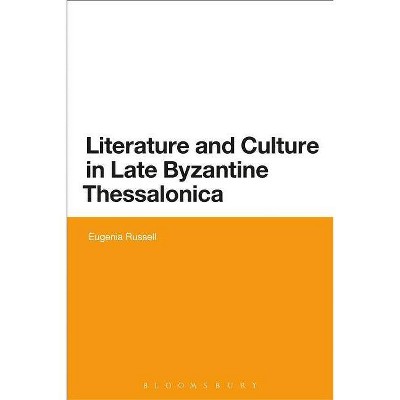
Literature and Culture in Late Byzantine Thessalonica - by Eugenia Russell (Paperback)
Similar Products

Products of same category from the store
All





Product info
<p/><br></br><p><b> Book Synopsis </b></p></br></br>The 'long' fourteenth century perhaps can be seen as Thessalonica's heyday. Alongside its growing commercial prowess, the city was developing into an important centre of government, where members of the Byzantine imperial family of the Palaiologoi ruled independently under full imperial titles, striking coinage and following an increasingly autonomous external policy. It was also developing into a formidable centre for letters, education, and artistic expression, due in part to Palaiologan patronage. This volume sets out the political and commercial landscape of Thessalonica between 1303 and 1430, when the city fell to the Ottoman Turks, before focusing on the literary and hymnographical aspects of the city's cultural history and its legacy. The cosmopolitan nature of urban life in Thessalonica, the polyphony of opinions it experienced and expressed, its multiple links with centres such as Constantinople, Adrianople, Athos, Lemnos and Lesvos, and the diversity and strength of its authorial voices make the study of the city's cultural life a vital part of our understanding of the Byzantine Eastern Mediterranean.<p/><br></br><p><b> About the Author </b></p></br></br><p><b>Eugenia Russell</b> is Lecturer in History at St Mary's University, Twickenham, UK. She is the author of <i>St Demetrius of Thessalonica: Cult and Devotion in the Middle Ages</i> (2010), 'Two Greek excerpts by Johannes Cuno (1463-1513) in London Arundel 550', <i>Renaissance Studies</i> 24 (2010), 'Donors, texts and images. Visualisation of the hagiographical cycle of St Panteleimon' (with Teodora Burnand), <i>Byzantion</i> 81 (2011) and the editor of <i>Spirituality in Late Byzantium</i> (2009).</p>
Price History
Price Archive shows prices from various stores, lets you see history and find the cheapest. There is no actual sale on the website. For all support, inquiry and suggestion messages communication@pricearchive.us