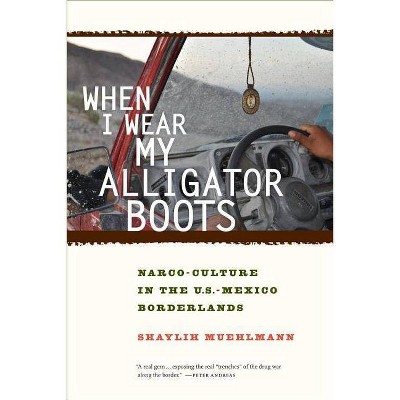
When I Wear My Alligator Boots, 33 - (California Public Anthropology) by Shaylih Muehlmann (Paperback)
Compare Prices Across Stores10000
All




More Non-Fiction at Target11+
All









Product Details
<p/><br></br><p><b> About the Book </b></p></br></br>"This book tells the story of the poor, often indigenous workers living in the borderlands who are recruited to work in the lowest echelons of the drug trade, as burreros (mules) and narcotraficantes (traffickers). Shayleh Muehlmann spent over a year researching in a small community in the borderlands. This book brings her stories to a wider public, narrating the experiences of a group of indigenous fishermen in northern Mexico who have become involved in the drug trade, and exploring how the narco-economy has provided a reprieve for men and women attempting to survive while their primary form of livelihood, fishing, has been criminalized by the state because of its alleged negative environmental impact. The book examines the rise of narcotrafficking as one of the economic alternatives sought by local people and how this work is seen by many as a way of resisting forms of domination imposed on them by both the Mexican and U.S. governments. Muehlmann explores a tension at the heart of the "war on drugs." For many men and women living in poverty, the narco-economy represents an alternative to the exploitation and alienation they experience trying to work in the borderland's legal economy which has been increasingly dominated by the presence of U.S.-owned maquiladoras (assembly plants) and ravaged by environmental degradation. Despite the lawlessness and violence of the cartels and the ruinous consequences this process has had for some of the most vulnerable people involved, narco-trafficking represents one of the few promises of upward mobility for the indigenous poor in Mexico's north. "--<p/><br></br><p><b> Book Synopsis </b></p></br></br><i>When I Wear My Alligator Boots </i>examines how the lives of dispossessed men and women are affected by the rise of narcotrafficking along the U.S.-Mexico border. In particular, the book explores a crucial tension at the heart of the "war on drugs" despite the violence and suffering brought on by drug cartels, for the rural poor in Mexico's north, narcotrafficking offers one of the few paths to upward mobility and is a powerful source of cultural meanings and local prestige.<br> <br> In the borderlands, traces of the drug trade are everywhere: from gang violence in cities to drug addiction in rural villages, from the vibrant folklore popularized in the narco-corridos of Norteña music to the icon of Jesús Malverde, the "patron saint" of narcos, tucked beneath the shirts of local people. In<i> When I Wear My Alligator Boots, </i>the author explores the everyday reality of the drug trade by living alongside its low-level workers, who live at the edges of the violence generated by the militarization of the war on drugs. Rather than telling the story of the powerful cartel leaders, the book focuses on the women who occasionally make their sandwiches, the low-level businessmen who launder their money, the addicts who consume their products, the mules who carry their money and drugs across borders, and the men and women who serve out prison sentences when their bosses' operations go awry.<br><p/><br></br><p><b> From the Back Cover </b></p></br></br>This book is a rare gem. In contrast to today's often overheated and sensationalized accounts of drug cartels and kingpins, Shaylih Muehlmann instead draws our attention to the too-often overlooked stories of the ordinary people at the margins of the drug economy in the U.S.-Mexico borderlands. Through fearless ethnographic research, she exposes the real trenches of the drug war along the border.--Peter Andreas, author of <i>Smuggler Nation: How Illicit Trade Made America</i> <p/> "This is an outstanding book . . . deeply moving in parts and simply fascinating in others. It makes clear interventions, but in a language that a general readership would enjoy even as scholars will assign this book in their classes."--Alexander Dawson, author of <i>First World Dreams: Mexico Since 1989</i> <p/> "This work provides an original and incredibly important contribution to a wide body of literature on the drug war, and particularly the escalation of drug war violence over the past decade."--Adrienne Pine, author of <i>Working Hard, Drinking Hard: On Violence and Survival in Honduras</i><p/><br></br><p><b> Review Quotes </b></p></br></br><br>"<i>When I Wear My Alligator Boots </i>is an ethnography of the drug industry's asymmetrical distribution of risks and rewards across the U.S.-Mexico border and beyond. Anthropologist Shaylih Muehlmann wrote intending to influence public opinion about drug policy, and she provides a powerful argument against US prohibition policies and the war on drugs."-- "Political and Legal Anthropology Review"<br><br>"Captivating from beginning to end and is difficult to put down once you start reading it. . . . A valuable resource for borderland scholars, Latin Americanists, and students in different academic disciplines interested in learning about how drug trafficking creates a narco-culture in the U.S.-Mexico borderlands."-- "American Anthropologist"<br><br>"Muehlmann's gift for narrative provides a powerful analytical lens."-- "Geographical Imaginations"<br><br>"Muehlmann powerfully connects Mexico's rural economy to the broader economic policies of the region, including NAFTA, and to the politics of the drug war in the United States and Mexico."-- "Anthropology Now"<br><p/><br></br><p><b> About the Author </b></p></br></br>Shaylih Muehlmann is Assistant Professor of Anthropology and Canada Research Chair in Language, Culture and the Environment at the University of British Columbia.