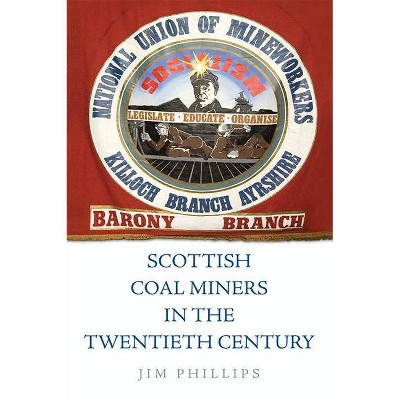
Scottish Coal Miners in the Twentieth Century - by Jim Phillips (Paperback)
Similar Products






Products of same category from the store
All





Product info
<p/><br></br><p><b> About the Book </b></p></br></br><p>Throughout the 20th century Scottish miners resisted deindustrialisation through collective action and by leading the campaign for Home Rule. This book shows that coal miners occupy a central position in Scotland's economic, social and political history. </p><p/><br></br><p><b> Book Synopsis </b></p></br></br><p>Examining working class welfare in the age of deindustrialisation through the experiences of the Scottish coal miner</p> <p>Throughout the twentieth century Scottish miners resisted deindustrialisation through collective action and by leading the campaign for Home Rule. This book argues that coal miners occupy a central position in Scotland's economic, social and political history, and highlights the role of miners in formulating labour movement demands for political-constitutional reforms that eventually resulted in the establishment of the Scottish Parliament in 1999. The book also uses the struggle of the mineworkers to explore working class wellbeing more broadly during the prolonged and politicised period of deindustrialisation that saw jobs, workplaces and communities devastated. </p><i> <p>Key features</p> <ul></i> <p> <li>Examines deindustrialisation as long-running, phased and politicised process</li> <p></p> <p> <li>Uses generational analysis to explain economic and political change</li> <p></p> <p> <li>Relates Scottish Home Rule to long-running debates about economic security and working class welfare</li> <p></p> <p> <li>Analyses the longer history of Scottish coal miners in terms of changing industrial ownership, production techniques and workplace safety</li> <p></p> <p> <li>Relates this economic and industrial history to changes in mining communities and gender relations</li> <p></p></ul><p/><br></br><p><b> From the Back Cover </b></p></br></br>Brings to light the vital role coal miners played in the social and political history of twentieth century Scotland Throughout the twentieth century Scottish miners resisted deindustrialisation through collective action and by leading the campaign for Home Rule. This book shows that coal miners occupy a central position in Scotland's economic, social and political history. It highlights the role of miners in formulating labour movement demands for political-constitutional reforms that helped create the conditions for the establishment of the Scottish Parliament in 1999. The author also uses the experiences of the miners to explore working class wellbeing more broadly throughout the prolonged and politicised period of deindustrialisation that culminated in the Thatcherite assault of the 1980s. Key Features - Analyses longer history of Scottish coal miners in terms of changing industrial ownership, production techniques, workplace safety - Examines deindustrialisation as long-running, phased and politicised process - Uses generational analysis to explain economic and political change - Relates Scottish Home Rule to long-running debates about economic security and working class welfare - Relates this economic and industrial history to changes in mining communities and gender relations Jim Phillips is Senior Lecturer in Economic & Social History at the University of Glasgow.<p/><br></br><p><b> Review Quotes </b></p></br></br><br><p>The book is a fitting tribute to the thousands of Scottish miners who toiled underground across the twentieth century and played an essential role in buildinga new society and defending it in the 1980s and 1990s. As an academic text it is a major piece of scholarship that will stand the test of time. However, just as importantly, its empathetic reconstruction of working class culture and politics will ensure that it will be just as warmly received by the general reader with an interest in the history of Scotland.</p>--Keith Gildart, University of Wolverhampton "Scottish Labour History "<br><p/><br></br><p><b> About the Author </b></p></br></br><p>Jim Phillips is Professor in Economic & Social History at the University of Glasgow, and author of <i>Scottish Coal Miners in the Twentieth Century</i> (Edinburgh University Press, 2019).<p>
Price History
Cheapest price in the interval: 29.95 on November 8, 2021
Most expensive price in the interval: 29.95 on December 22, 2021
Price Archive shows prices from various stores, lets you see history and find the cheapest. There is no actual sale on the website. For all support, inquiry and suggestion messages communication@pricearchive.us