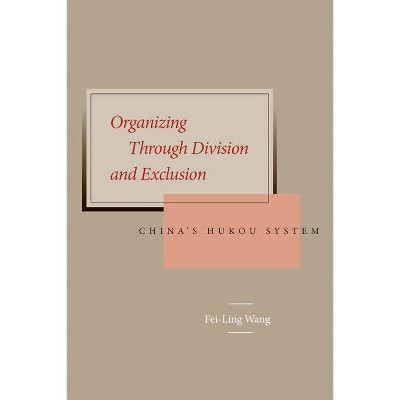
Organizing Through Division and Exclusion - by Fei-Ling Wang (Hardcover)
Similar Products


Products of same category from the store
All




Product info
<p/><br></br><p><b> About the Book </b></p></br></br>This is an original and comprehensive examination of China's <i>hukou</i> (household registration) system, a system that fundamentally determines the Chinese way of life and shapes China's sociopolitical structure and socioeconomic development.<p/><br></br><p><b> Book Synopsis </b></p></br></br>This is an original and comprehensive examination of China's <i>hukou</i> (household registration) system, a system that fundamentally determines the Chinese way of life and shapes China's sociopolitical structure and socioeconomic development.<p/><br></br><p><b> From the Back Cover </b></p></br></br>"What makes this book indispensable for understanding Chinese state-building is its comprehensive analysis of the hukou (household registration) system, a little understood institution responsible for the rural-urban inequality in contemporary China. . . The book's excellent organization allows readers to select relevant chapters and circumvent potholes in the overarching narrative."--Choice<br>"Organizing Through Division and Exclusion is a long-overdue work that will provide and excellent source of information on the ins and outs of China's registration system."--The China Journal<p/><br></br><p><b> Review Quotes </b></p></br></br><br><i>Organizing Through Division and Exclusion</i> is a long-overdue work that will provide and excellent source of information on the ins and outs of Chinas registration system.--<i>The China Journal</i><br><br>As the first published comprehensive examination of China's <i>hukou</i> (household registration) system, Fei-Ling Wang's book has certainly made a significant contribution to helping us better understand China's rapid economic development in general, and its social control and stratification in particular.--<i>Pacific Affairs</i><br><br>Readers will have no doubt, after reading this book, that China's <i>Hukou</i> system discriminates against the 70 percent of its population who just happen to be born in the rural areas.--<i>Journal of Chinese Political Science</i><br><br>Wangs book is a major contribution to our understanding of a system that has largely escaped attention, particularly in its security aspect as a means of control over targeted people, because its operations are considered state secrets. . . . This work provides us with the most comprehensive account so far, and is an indispensable tool for specialists in contemporary China, while being completely accessible to the general public.--<i>China Perspectives</i><br><br>What makes this book indispensable for understanding Chinese state-building is its comprehensive analysis of the <i>hukou</i> (household registration) system, a little understood institution responsible for the rural-urban inequality in contemporary China. . . The book's excellent organization allows readers to select relevant chapters and circumvent potholes in the overarching narrative.--<i>Choice</i><br><p/><br></br><p><b> About the Author </b></p></br></br>Fei-ling Wang is Associate Professor at the Georgia Institute of Technology's Sam Nunn School of International Affairs. He has published two earlier books, <i>Institutions and Institutional Change in China: Premodernity and Modernization</i> (1998), and <i>From Family to Market: Labor Allocation in Contemporary China</i> (1998).
Price History
Price Archive shows prices from various stores, lets you see history and find the cheapest. There is no actual sale on the website. For all support, inquiry and suggestion messages communication@pricearchive.us