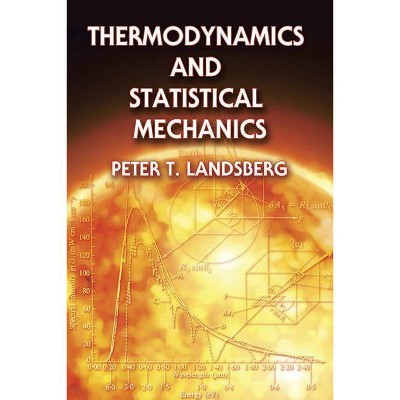
Thermodynamics and Statistical Mechanics - (Dover Books on Physics) by Peter T Landsberg (Paperback)
Similar Products



Products of same category from the store
All










Product info
<p/><br></br><p><b> About the Book </b></p></br></br><p>Innovative, wide-ranging treatment, suitable for advanced undergraduates and graduate students, covers negative temperatures and heat capacities, general and special relativistic effects, black hole thermodynamics, gravitational collapse, and more. Problems with worked solutions. 1978 edition.<p/><br></br><p><b> Book Synopsis </b></p></br></br>Innovative and wide-ranging, this treatment combines precise mathematic style with strong physical intuition. Written by a well-known physicist for advanced undergraduates and graduate students, the book's broad spectrum of applications includes negative temperatures and heat capacities, general and special relativistic effects, black hole thermodynamics, gravitational collapse, energy conversion problems, and efficiencies including simple heat pump theory.<br>The basic ideas and mathematical formulation of thermodynamics are presented in a modern, clear way with the Carathéodory method, which is employed fully, but in simple terms and without advanced mathematics. Statistical mechanics are based on ideas from information theory, and the simpler ideal systems are covered in close connection with the thermodynamic treatment. Mathematical steps are displayed in detail, and abundant problems include worked solutions.<p/><br></br><p><b> From the Back Cover </b></p></br></br><p>Innovative and wide-ranging, this treatment combines precise mathematic style with strong physical intuition. Written by a well-known physicist for advanced undergraduates and graduate students, the book's broad spectrum of applications includes negative temperatures and heat capacities, general and special relativistic effects, black hole thermodynamics, gravitational collapse, energy conversion problems, and efficiencies including simple heat pump theory.<br>The basic ideas and mathematical formulation of thermodynamics are presented in a modern, clear way with the Carathéodory method, which is employed fully, but in simple terms and without advanced mathematics. Statistical mechanics are based on ideas from information theory, and the simpler ideal systems are covered in close connection with the thermodynamic treatment. Mathematical steps are displayed in detail, and abundant problems include worked solutions. <br>Dover (2014) unabridged, corrected republication of the edition originally published by Oxford University Press, Oxford, England, 1978. <br>See every Dover book in print at<br><b>www.doverpublications.com</b><p/><br></br><p><b> About the Author </b></p></br></br>Peter T. Landsberg (1922-2010) taught at University College Cardiff from 1959 to 1971 and held the chair in Applied Mathematics at the University of Southampton from 1982 to 1987. He wrote, edited, and coauthored 11 books, including Dover's <i>Thermodynamics and Statistical Mechanics, </i> and more than 400 scientific papers.
Price History
Price Archive shows prices from various stores, lets you see history and find the cheapest. There is no actual sale on the website. For all support, inquiry and suggestion messages communication@pricearchive.us