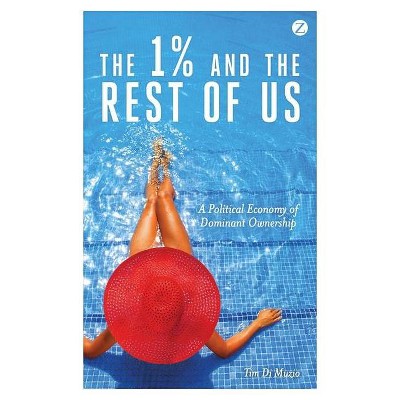
The 1% and the Rest of Us - by Tim Di Muzio (Paperback)
Similar Products




Products of same category from the store
All

Product info
<p/><br></br><p><b> About the Book </b></p></br></br><p>While the Occupy movement faces many strategic and organizational challenges, one of its major accomplishments has been to draw global attention to the massive disparity of income, wealth and privilege held by 1% of the population in nations across the world. In "The 1% and the Rest of Us," Tim Di Muzio explores what it means to be part of a soc<p/><br></br><p><b> Book Synopsis </b></p></br></br>One of the major accomplishments of the Occupy movement has been to draw global attention to the massive disparity of income, wealth, and privilege concentrated in one percent of the world's population. In <i>The 1% and the Rest of Us</i>, Tim Di Muzio offers the first empirical and theoretical study of the culture, politics, built environments, and social behavior of this extremely wealthy minority. In doing so, he examines the fallout of this socio-economic order and its devastating consequences for the other ninety-nine percent of the population. <p/> Drawing on case studies and incorporating provocative insights into the worldviews, politics, and lifestyles of the economic elite, Di Muzio reveals how the one percent is creating a world unto themselves in which the accumulation of wealth has become a powerful symbol of control over society and the natural environment. This timely and thought-provoking book offers the first in-depth analysis of the global political economy of the one percent, and, at the same time, demonstrates how unflagging resistance can continually challenge and call into question its power and dilute its influence.<p/><br></br><p><b> Review Quotes </b></p></br></br><br><p>"Distills the concepts of capitalism, political economy, finance, inequality, the profligacy of the 1%-ers, and much more in morally coherent chunks of need-to-know information. It is a superb book." --<i>Dissident Voice</i> <p/>"Capital is power, wealth is social, the rich are undeserving, growth is unsustainable. In this timely book Di Muzio takes aim not only at the emergence of a global super rich, but also at the ideologies of wealth generation that keep them in their place and us in ours - an indignant call to put people and planet above profit and status." --<i>Amin Samman, City University London</i> <p/>"Tim Di Muzio debunks the radically antisocial belief that wealth is the sole result of individual efforts and talents. His contribution is novel and original, but it is also a significant part of a growing clamour for change." --<i>Danny Dorling, author of Inequality and the 1% and Population 10 Billion</i> <p/>"Tim Di Muzio has produced a remarkable book: remarkable for its original reading of available evidence on the rise of the 1%; remarkable for the creative interweaving of empirical findings and theoretical insights; and remarkable for its politicization of the inequality issue. Di Muzio gives the Capital as Power approach a concrete and down-to-earth bite." --<i>Henk Overbeek, VU University Amsterdam</i> <p/>"A highly accessible must-read primer for anyone interested in the world's dominant capital, its incessant drive to accumulate power, and the impact this has on our lives and future." --<i>Jonathan Nitzan, co-author of Capital as Power</i> <p/>"This compelling and original work is a must read: it brilliantly illuminates a world dominated by a tiny, immensely powerful ruling class who have accumulated enormous wealth, even during the global economic crisis. It explains why and how that has happened, who they are, and not least how such plutocratic power can be resisted and transformed to better serve the majority of people on the planet." --<i>Stephen Gill, York University, Toronto</i></p><br><p/><br></br><p><b> About the Author </b></p></br></br><p>Tim Di Muzio is senior lecturer in international relations and political economy at the University of Wollongong in Australia. He currently edits the journal <i>Review of Capital as Power</i>.<br>Tim Di Muzio is senior lecturer in international relations and political economy at the University of Wollongong in Australia. He currently edits the journal <i>Review of Capital as Power</i>.</p>
Price History
Cheapest price in the interval: 24.99 on October 27, 2021
Most expensive price in the interval: 24.99 on November 8, 2021
Price Archive shows prices from various stores, lets you see history and find the cheapest. There is no actual sale on the website. For all support, inquiry and suggestion messages communication@pricearchive.us