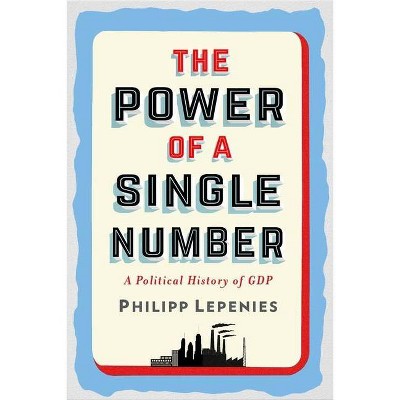
The Power of a Single Number - by Philipp Lepenies (Hardcover)
Similar Products









Products of same category from the store
All









Product info
<p/><br></br><p><b> About the Book </b></p></br></br>A narrative-driven political history of the most important economic statistic in the world.<p/><br></br><p><b> Book Synopsis </b></p></br></br>Widely used since the mid-twentieth century, GDP (gross domestic product) has become the world's most powerful statistical indicator of national development and progress. Practically all governments adhere to the idea that GDP growth is a primary economic target, and while criticism of this measure has grown, neither its champions nor its detractors deny its central importance in our political culture. <p/>In <i>The Power of a Single Number</i>, Philipp Lepenies recounts the lively history of GDP's political acceptance--and eventual dominance. Locating the origins of GDP measurements in Renaissance England, Lepenies explores the social and political factors that originally hindered its use. It was not until the early 1900s that an ingenuous lone-wolf economist revived and honed GDP's statistical approach. These ideas were then extended by John Maynard Keynes, and a more focused study of national income was born. American economists furthered this work by emphasizing GDP's ties to social well-being, setting the stage for its ascent. GDP finally achieved its singular status during World War II, assuming the importance it retains today. Lepenies's absorbing account helps us understand the personalities and popular events that propelled GDP to supremacy and clarifies current debates over the wisdom of the number's rule.<p/><br></br><p><b> Review Quotes </b></p></br></br><br>Lepenies's absorbing account helps us understand the personalities and popular events that propelled GDP to dominance, clarifying current debates over the wisdom of the number's rule.--800-CEO-READ<br><br>Recommended.--CHOICE<br><br>This little book about a big number will impress readers who might never have previously considered the statistics underlying our lives.--Publishers Weekly<br><br>[An] informative book.--Richard N. Cooper "Foreign Affairs "<br><br>A great book on understanding why GDP was put at the center of the political and economic framework that has driven the world over the past sixty years and why this choice led to the underestimating of other issues, such as socioeconomic inequalities and environmental degradation. The Power of a Single Number also provides insights on how to build a 'post GDP' era, especially in the context of a possible future 'secular stagnation.'--Enrico Giovannini, University of Rome<br><br>By asking how GDP became the most influential economic statistic of our time, Lepenies provides a fascinating new perspective on the history of empirical economics. Economists play important roles in his account, but ultimately it was politics and the priorities of wartime that drove the demand for GDP measurement. While many economists today are well aware of its limitations, political inertia keeps GDP on its throne.--Martin Ravallion, Georgetown University<br><br>It is an amazing but little-remarked fact that governments all over the world take as their top economic objective the increase of one number: gross domestic product. Philipp Lepenies traces how this strange unanimity came to be, taking the reader on a colorful journey through England, Germany, and the United States and bringing things into the present with an account of current debates about replacing or supplementing GDP with other indicators of welfare. <i>The Power of a Single Number</i> is beautifully written and easily accessible to anyone who wants to know more about what lies behind the world's most powerful number.--Robert H. Wade, London School of Economics. Leontief Prize winner, 2008.<br><p/><br></br><p><b> About the Author </b></p></br></br>Philipp Lepenies is guest professor for social science at the Free University of Berlin. His research focuses on the success of economic ideas and concepts in politics. He is also the author of <i>Art, Politics, and Development: How Linear Perspective Shaped Policies in the Western World</i> (2013).
Price History
Price Archive shows prices from various stores, lets you see history and find the cheapest. There is no actual sale on the website. For all support, inquiry and suggestion messages communication@pricearchive.us