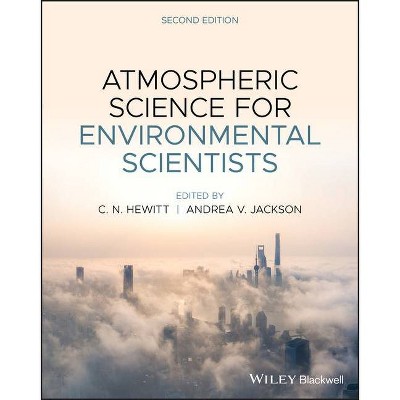
Atmospheric Science for Environmental Scientists - 2nd Edition by C Nick Hewitt & Andrea V Jackson (Paperback)
Similar Products



Products of same category from the store
All








Product info
<p/><br></br><p><b> About the Book </b></p></br></br>"The causes, history and distributions of the Earth's climates are introduced in this chapter. The combination of the distribution of incoming solar radiation across the Earth's surface and the Earth's rotation, drive and shape the observed atmosphere-ocean circulation. Important factors, which determine changes in climate, include palaeo-geography, greenhouse gas concentrations, changing orbital parameters, and varying ocean heat transport. One of the major controls of climatic changes is the greenhouse gas concentration of the atmosphere, in particular that of carbon dioxide. Before the Eocene-Oligocene boundary ( 34 Myr ago) the atmosphere-ocean circulation sup-ported a warm atmosphere and ocean, with both poles free of permanent ice. At the Eocene-Oligocene boundary the atmosphere-ocean circulation changed to a form similar to the present, and the first evidence of an Antarctic ice sheet is found. Falling atmospheric carbon dioxide levels probably caused this change. The waxing and waning of massive temperate latitude continental ice sheets characterize the climate of the past million years. Recent cli-mate changes are described and evidence produced that they are largely driven by anthropogenic generated at-mospheric carbon dioxide. In particular recent climate changes are causing the expansion of the tropical zone and a retreat of the polar zones"--<p/><br></br><p><b> Book Synopsis </b></p></br></br><p><b>Enlightens readers on the realities of global atmospheric change, including global warming and poor air quality</b></p> <p>Climate change and air pollution are two of the most pressing issues facing Mankind. This book gives undergraduate and graduate students, researchers and professionals working in the science and policy of pollution, climate change and air quality a broad and up-to-date account of the processes that occur in the atmosphere, how these are changing as Man's relentless use of natural resources continues, and what effects these changes are having on the Earth's climate and the quality of the air we breathe.</p> <p>Written by an international team of experts, <i>Atmospheric Science for Environmental Scientists, 2<sup>nd</sup> Edition </i>provides an excellent overview of our current understanding of the state of the Earth's atmosphere and how it is changing. The first half of the book covers: the climate of the Earth; chemical evolution of the atmosphere; atmospheric energy and the structure of the atmosphere; biogeochemical cycles; and tropospheric chemistry and air pollution. The second half looks at cloud formation and chemistry; particulate matter in the atmosphere; stratospheric chemistry and ozone depletion; boundary layer meteorology and atmospheric dispersion; urban air pollution; and global warming and climate change science.</p> <ul> <li>Provides succinct but detailed information on all the important aspects of atmospheric science for students</li> <li>Offers the most up-to-date treatment of key issues such as stratospheric chemistry, urban air pollution, and climate change</li> <li>Each chapter includes basic concepts, end-of-section questions, and more in-depth material</li> <li>Features contributions from the best experts and educators in the field of atmospheric science</li> </ul> <p><i>Atmospheric Science for Environmental Scientists, 2<sup>nd</sup> Edition</i> is an invaluable resource for students, teachers, and professionals involved in environmental science. It will also appeal to those interested in learning how the atmosphere works, how humankind is changing its composition, and what effects these changes are leading to.</p><p/><br></br><p><b> From the Back Cover </b></p></br></br><p><b>Enlightens readers on the realities of global atmospheric change, including global warming and poor air quality</b> <p>Climate change and air pollution are two of the most pressing issues facing Mankind. This book gives undergraduate and graduate students, researchers and professionals working in the science and policy of pollution, climate change and air quality a broad and up-to-date account of the processes that occur in the atmosphere, how these are changing as Man's relentless use of natural resources continues, and what effects these changes are having on the Earth's climate and the quality of the air we breathe. <p>Written by an international team of experts, <i>Atmospheric</i> <i>Science for Environmental Scientists, </i> Second Edition<i></i> provides an excellent overview of our current understanding of the state of the Earth's atmosphere and how it is changing. The first half of the book covers: the climate of the Earth; chemical evolution of the atmosphere; atmospheric energy and the structure of the atmosphere; biogeochemical cycles; and tropospheric chemistry and air pollution. The second half looks at cloud formation and chemistry; particulate matter in the atmosphere; stratospheric chemistry and ozone depletion; boundary layer meteorology and atmospheric dispersion; urban air pollution; and global warming and climate change science. <ul> <li>Provides succinct but detailed information on all the important aspects of atmospheric science for students</li> <li>Offers the most up-to-date treatment of key issues such as stratospheric chemistry, urban air pollution, and climate change</li> <li>Each chapter includes basic concepts, end-of-section questions, and more in-depth material</li> <li>Features contributions from the best experts and educators in the field of atmospheric science</li> </ul> <p><i>Atmospheric Science for Environmental Scientists, </i> Second Edition is an invaluable resource for students, teachers, and professionals involved in environmental science. It will also appeal to those interested in learning how the atmosphere works, how humankind is changing its composition, and what effects these changes are leading to.<p/><br></br><p><b> About the Author </b></p></br></br><p><b>NICK HEWITT, PHD, </b> is Distinguished Professor of Atmospheric Chemistry at Lancaster University, UK. His main research interests are in understanding how the biosphere and the atmosphere interact, how emissions of trace gases from the surface affect the composition and chemistry of the atmosphere, and how the changing atmospheric environment affects the world we live in. <p><b>ANDREA V. JACKSON, PHD, </b> recently retired as Professor of Student Education and Engagement at the University of Leeds, UK. As well as conducting research in atmospheric chemistry, she worked with the UK's National Centre for Atmospheric Science on the development of their education and training programmes.
Price History
Price Archive shows prices from various stores, lets you see history and find the cheapest. There is no actual sale on the website. For all support, inquiry and suggestion messages communication@pricearchive.us