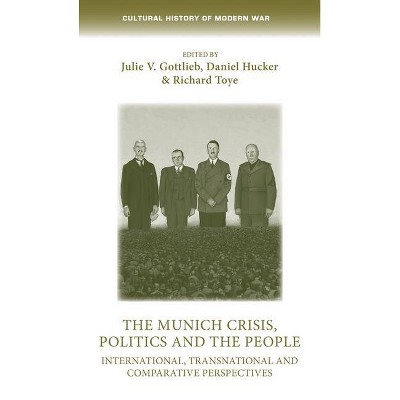
The Munich Crisis, Politics and the People - (Cultural History of Modern War) by Julie Gottlieb & Daniel Hucker & Richard Toye & Ana Carden-Coyne
Compare Prices Across Stores10000
All



More Non-Fiction at Target11+
All








Product Details
<p/><br></br><p><b> About the Book </b></p></br></br>Bringing together leading historians, this volume offers a vital and timely reassessment of Munich Crisis of 1938 from the point of view of the politicians, the people, and public opinion. It takes into account the profound social, cultural, and psychological effects of the crisis, hitherto neglected aspects of this clash between democracy and dictatorship.<p/><br></br><p><b> Book Synopsis </b></p></br></br>The Munich Crisis of 1938 had major diplomatic as well as personal and psychological repercussions. As much as it was a climax in the clash between dictatorship and democracy, it was also a People's Crisis and an event that gripped and worried the people around the world. The traditional approach has been to examine the crisis from the vantage points of high politics and diplomacy. Traditional approaches have failed to acknowledge the profound social, cultural and psychological impacts of diplomatic events, an imbalance that is redressed in this volume. Taking a range of national examples and using a variety of methods, <i>The Munich Crisis, Politics and the People</i> recreates the experience of living through the crisis in Czechoslovakia, Germany, France, Britain, Hungary, the Soviet Union and the USA.<p/><br></br><p><b> From the Back Cover </b></p></br></br>The Munich Crisis of 1938 was the climax of the deepening diplomatic and political crisis of the post-war years. The effects of the crisis and the feelings aroused by the promise of a prolonged period of European peace were widespread across borders, regions, classes and generations. It was, in fact, a People's Crisis. It dominated the thoughts and feelings not only of those who held power but also of those who had none. Immediately after the signing of the Four Power Agreement at Munich, the dominant feelings in Britain and France were those of relief, deliverance, and gratitude to the peacemakers, mixed in with shame and guilt at the betrayal of worthy allies. The turbulent events of September 1938 aroused substantial public excitement, yet the 'public', the 'people', the 'material', and the 'popular' have hitherto been marginalised within the scholarship. This collection provides a corrective to the longstanding tendency to consider the Munich crisis almost exclusively from the viewpoint of politicians and diplomats. It considers a range of national contexts: Czechoslovakia, Germany, France, Britain, Hungary, the USA and the Soviet Union. <i>The Munich Crisis, politics and the people</i> illuminates the crisis from the vantage points of the social, the cultural, the material, the emotional, and public opinion, offering an alternative and more inclusive narrative of the last, precarious months of peace.<p/><br></br><p><b> About the Author </b></p></br></br>Julie V. Gottlieb is Professor of Modern History at the University of Sheffield Daniel Hucker is Assistant Professor of History at the University of Nottingham Richard Toye is Professor of Modern History at the University of Exeter