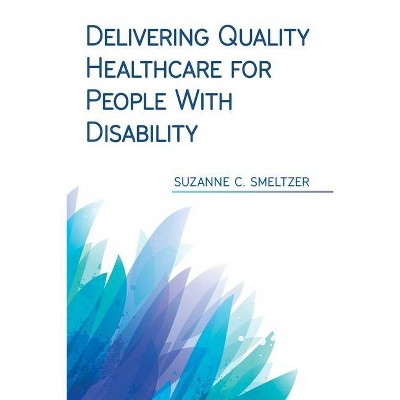
Delivering Quality Healthcare for People With Disability - by Suzanne C Smeltzer (Paperback)
Similar Products










Products of same category from the store
All









Product info
<p/><br></br><p><b> About the Book </b></p></br></br>Disability is a universal aspect of the human experience. It will affect all of us, either directly or indirectly, at some point in our lives. Healthcare professionals frequently provide care for and communicate with people who have disability. Many care providers have acknowledged that additional education would help them deliver optimal evidence-based care. The educational gap has broad implications and repercussions for the care of this population. Delivering Quality Healthcare for People With Disability provides a road map for nurses, nursing students, and other healthcare professionals to deliver quality healthcare for individuals with dis-ability. From social determinants of health to disability models to an understanding of different types of disability, author Suzanne Smeltzer helps nurses take the lead in redefining education and addressing the needs of people with disability.<p/><br></br><p><b> Book Synopsis </b></p></br></br><p>Those with disability-be it mild and a mere inconvenience, or one that necessitates the use of high-tech support for survival-have repeatedly reported that their healthcare needs are not adequately addressed by healthcare providers. Most healthcare professionals, including nurses, are unfamiliar with the consequences of disabling conditions in the lives of individuals with disability. They lack knowledge about how to communicate effectively with those with all types of disability, do not consider the effect of individuals' disability on their ability to participate in health-promotion efforts, harbor negative attitudes and bias toward them, stereotype them, and often perceive them as unable (or unwilling) to take an active part in their own care.</p><p>Ineffective communication on the part of healthcare professionals when interacting with individuals with disability has broad implications and repercussions. Healthcare providers who believe they know best, and are the experts on disability, will continue to ignore the wishes and preferences of individuals with disability and their desire to make decisions about their own lives and healthcare. Many healthcare professionals presume people with disability are reluctant to participate in health promotion. </p><p>Individuals with disability have reported that healthcare providers are uncomfortable and unwilling to discuss issues related to sex and sexuality with them. They have further reported that healthcare providers assume that they are uninterested (or perhaps believe that they should be uninterested) in sexual relationships, intimacy, pregnancy, and childbearing. Women with disability who have elected to become mothers and have sought out prenatal care have reported that their healthcare providers' first assumption was that the reason individuals with disability; these agencies and organizations have identified changing the educational preparation of healthcare professionals as a primary strategy and an important first step.</p><p>Several organizations, with input from individuals with disability, have developed competencies that should be expected of all healthcare professionals who interact with individuals with disability. The Alli-ance for Disability in Health Care Education has urged nursing, medicine, and other healthcare professions to endorse these competencies with the goal of moving forward in the effort to improve the healthcare of individuals with disability. Nurses have been very involved in the development of these competencies from the beginning of the process. Several nursing organizations, including Sigma, have endorsed the cross-discipline competencies developed by the Alliance for Disability in Health Care Education (2019).</p><p>This book is based on the principle and belief that all healthcare professionals regardless of discipline, level of education, or role within the healthcare system have a role in caring for individuals with disability. As such, they need a basic understanding of the issue of disability to provide appropriate, optimal, and sensitive healthcare to those with disability. These issues and more are addressed in the chapters of this book. It is intended to provide information to nurses, nursing students, and other healthcare professionals to enable them to communicate with and provide quality healthcare to individuals with disability. </p>
Price History
Price Archive shows prices from various stores, lets you see history and find the cheapest. There is no actual sale on the website. For all support, inquiry and suggestion messages communication@pricearchive.us