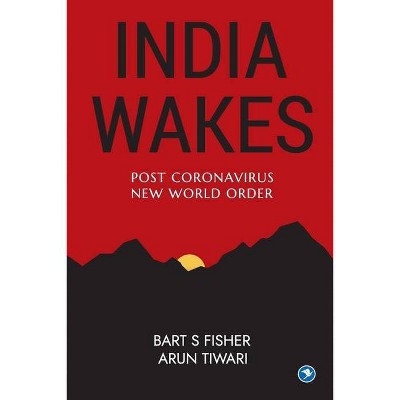
India Wakes - by Bart S Fisher & Arun Tiwari (Paperback)
Similar Products







Products of same category from the store
All



Product info
<p/><br></br><p><b> Book Synopsis </b></p></br></br><p>The world into which India wakes is a nightmare decimated by a global recession, caused by the coronavirus pandemic originating in China and engulfing most of the world. Was the coronavirus a Black Swan event turned into an opportunity by China to dominate the world? Would the trust deficit heightened by China's ambushing Indian soldiers become a snowball or fade away? Has the US$ 5 trillion Indian economy dream become a mirage already? What all would fall into the fault lines of socio-economic inequality?</p><p><br></p><p>Will there be a new Cold War between the United States and China, and if there is one, how can India avoid becoming collateral damage? Is it possible that the United States, India, and China build a new world order based on mutual needs and interests, or is a hegemon power already on the prowl? Anchored in hope, rather than adding to anxiety, and seeing present times as a teachable moment of human history, the book recalls the past and contextualizes it for the next politico-economic shift that is currently unfolding in the world. Every nation must find its bearing and position itself in the matrix of a de-globalized world.</p><p><br></p><p>The authors are considered good readers of their times. They have in common firsthand experience of traveling in China extensively and seeing things there from close quarters over a long period of time. They have come together to write this book at a time when the tattered cloth of globalization is displaying quite a bit of nakedness of the socio-economic inequality that it has created. It is foolish to imagine a world without war, but the future wars will use space, cyberspace, and trade as weapons and finance as ammunition. Nor can we rule out the use of biological warfare as another technique for obtaining global influence after the coronavirus pandemic. The future world order will rest on who will be ahead in developing Artificial Intelligence, robotic weapons, and products based on converging Bio-Nano-information technologies and cognitive sciences. The book takes the reader inside the deep rabbit hole of a wonderland where strange creatures will speak to Alice if the corollary to the inevitable decoupling of the U.S. and China could be the Indo-U.S. tango. Of course, both the United States and India being vibrant, dramatic, and acrimonious democracies, the deal would be complex, involving interesting bargains, collaterals, and freebies, and it may even work out. </p><p><br></p><p>The book introduces to the readers, particularly Indians, a glimpse of the great nation building of the United States of America. Divided into five parts of five chapters each, the book offers a broad picture of the ongoing upheaval as it has been seen happening by the authors and tries to connect the dots floating in the realm of possibilities. The rise of China is a great phenomenon, and Chinese leaders and the people did something unprecedented in the history of the world in bringing about this meteoric rise. New India has already launched itself out of regional isolation into the geo-politics and global economic orders. The trajectory of New India is not yet clear. This book also presents the possible danger of the United States and China becoming adversaries in a new Cold War and advocates a balanced role by India to avoid such a catastrophe. With more than four billion people on earth still living in poverty, humanity needs progress and cooperation and not destruction and conflict. Calling the present chaotic times, a "Teachable Moment" in the history of the world, this book examines New India making a possible triad with the United States and China to make planet earth more livable. </p><p/><br></br><p><b> Review Quotes </b></p></br></br><br><p>Historians may conclude that 2020 marked the end of the post-World War II era. This majestic work analyzes the post coronavirus world order and India's role in it. Will India pursue a regional strategy that can contain a resurgent China? What are the regional and global implications of India's turn to greater nationalism under the BJP? Has the United States lost its place as the indispensable superpower? What new trade alliances and trade patterns may arise? These issues and more are addressed by authors, who possess extraordinary credentials as students of these troubled times. I recommend this book highly, the first major study to consider the fate of the triad-India, China, and the United States-in the post coronavirus new world order.</p><p>- Stuart S. Malawer</strong>, J.D., Ph.D., Distinguished Service Professor of Law and International Trade at George Mason University. Delegate on various Virginia gubernatorial trade delegations to India.</em></p><p><br></p><p>India wakes in a world that is emerging from the Covid-19 pandemic.The authors demonstrate how this disaster has accelerated trends already under way, including de-globalization, the rise of populist authoritarian leaders, and intensifying rivalry between China and the United States. They argue that India should take advantage of the opportunity that U.S. decoupling from China will provide, including supply chain movement away from China and into India. This sweeping, clearly written, and riveting magisterial study of India's role in the new world order is a must-read for students of the relationship between India, China, and the United States.</p><p>- Richard W. Rahn</strong>, Ph.D., </em> honorary Doctor of Laws, American economist, columnist, and entrepreneur. Current Chairman of Improbable Success Productions and the Institute for Global Economic Growth.</em></p><br>
Price History
Price Archive shows prices from various stores, lets you see history and find the cheapest. There is no actual sale on the website. For all support, inquiry and suggestion messages communication@pricearchive.us