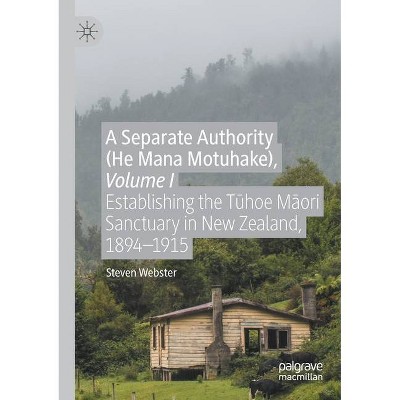
A Separate Authority (He Mana Motuhake), Volume I - by Steven Webster (Paperback)
Similar Products






Products of same category from the store
All





Product info
<p/><br></br><p><b> Book Synopsis </b></p></br></br>Chapter 1: Introduction1. A Brief Historical Overview2. Ngāi Tūhoe and Te Urewera3. Historical Background of the Urewera District Native Reserve4. A Preview of the Following Chapters<b>Part I: Tūhoe <i>hap</i><i>ū</i> and the Establishment of the Urewera District Native Reserve</b>Chapter 2: The Tūhoe <i>rohe p</i><i>ō</i><i>tae</i> and the Urewera District Native Reserve Commission 1. The general procedures and findings of the commission2. The legitimacy of the Commission among Tūhoe Chapter 3: Difficulties of the commission defining Urewera blocks by <i>hap</i><i>ū</i>1. Introduction2. Changes in identification of Urewera hapū 1896-19073. Procedural precedents and compromises in the Te Waipotiki case4. Establishing a system for assignment of relative shares5. The resolution to expedite hearings and merge claims6. The aborted plan for radical block amalgamationsChapter 4: The Tamaikoha <i>hap</i><i>ū</i> branch: internal social organization1. Introduction: the Tamaikoha kāwai or hapū branch2. Sibling groups and surnames3. Spouses, mothers, marriages, and land rights 4. Difficulties determining hapū affiliations of the Tamaikoha hapū branchChapter 5: The Tamaikoha <i>hap</i><i>ū</i> branch: <i>hap</i><i>ū</i> affiliations1. Introduction2. Potential and active hapū affiliations3. Ngāi Tokotuai hapū and claims to Tauwhare Manuka and Pukepohatu blocks4. Te Urewera hapū and the claims to Whaitiripapa block5. Ngāti Tāwhaki hapū and the claims to Tarapounamu-Matawhero block6. Further awards without formal claims7. Block committee appointments8. ConclusionChapter 6: Tūhoe <i>hap</i><i>ū</i> organization and the amalgamation plan1. Introduction2. The Ōhāua te Rangi amalgamation3. The Parekohe amalgamation4. Conclusion<b>Part II: Kinship and power in Ruatāhuna and Waikaremoana 1899-1913</b>Chapter 7: The Ruatāhuna-Waikaremoana migrant marriage alliance by 18981. Introduction2. The migrant marriage alliance between Ruatāhuna and Waikaremoana areas3. Kinship, affinity, and political activities of marriage alliance leaders4. ConclusionChapter 8: Confrontations over Waikaremoana and Ruatāhuna 1899-19071. Introduction2. Investigation of the Waikaremoana block 1899 - 19073. Investigation of the Ruatāhuna block 1899-19074. ConclusionChapter 9: The Ruatāhuna Partition, 19121. Introduction2. Manawarū the 'internal boundary dispute'3. Numia Kererū builds his case4. ConclusionChapter 10: Some Plausible Explanations1. Introduction2. Behind the scenes of the Ruatāhuna and Waikaremoana hearings 1900-19033. The emergence of Numia Kererū's strategy 1903-19074. Arranging succession to Te Whenuanui II's title5. Conclusion<b>Part III: Conclusion </b>Chapter 11: A Contemporary Retrospect: <b> </b>Getting to Know <i>Ngāi Tūhoe</i>1. 'Kaupois' lost in Te Urewera2. <i>Tatau pounamu</i>?: belatedly understanding some marriages 1890s - 1950s3. The 1983 Tekaumārua at Ōhāua <p/><p/><br></br><p><b> From the Back Cover </b></p></br></br><p>"Tūhoe mana motuhake vs the force of New Zealand colonialism. This is a patient and perceptive work unraveling stratagems of contrasting ambition so we may comprehend the cultural instincts of 1890-1920 Aotearoa. Dr. Webster proves his deep understanding of kinship dynamics, hapū politics and the Tūhoe passion for autonomy."</p> <p>--Tāmati Kruger, Representative in the Tūhoe Te Uru Taumatua, New Zealand</p><p>The resistance of the Tūhoe Māori of New Zealand to colonisation began more than century before the final return of their sanctuary in the Urewera mountains by the Crown in 2014. In Volume I of <i>A Separate Authority (He Mana Motuhake), </i> Steven Webster provides an ethnohistorical reconstruction of the establishment in New Zealand of a rare case of Maori home-rule over their traditional domain, backed by a special statute and investigated by a Crown commission, the majority of whom were Tūhoe leaders. This relatively benevolent colonial policy enabled the Tūhoe to control the establishment of their vast Native Reserve in a way that entrenched their social organisation, particularly their traditional deployment of kin-based power, while at once manipulating the power of the Crown to their joint advantage from 1894 to 1908. In Volume II, Webster documents how this same form of resistance enabled the Tūhoe to withstand predatory Crown policies between 1908 and 1926, thereby retaining remnants of their ancestral sanctuary--which later became the basis upon which they won statutory control of the territory.</p><p/><br></br><p><b> About the Author </b></p></br></br><p></p><p></p><p>The resistance of the Tūhoe Māori of New Zealand to colonisation began more than century before the final return of their sanctuary in the Urewera mountains by the Crown in 2014. In Volume I of <i>A Separate Authority (He Mana Motuhake), </i> Steven Webster provides an ethnohistorical reconstruction of the establishment in New Zealand of a rare case of Maori home-rule over their traditional domain, backed by a special statute and investigated by a Crown commission, the majority of whom were Tūhoe leaders. This relatively benevolent colonial policy enabled the Tūhoe to control the establishment of their vast Native Reserve in a way that entrenched their social organisation, particularly their traditional deployment of kin-based power, while at once manipulating the power of the Crown to their joint advantage from 1894 to 1908. In Volume II, Webster documents how this same form of resistance enabled the Tūhoe to withstand predatory Crown policies between 1908 and 1926, thereby retaining remnants of their ancestral sanctuary--which later became the basis upon which they won statutory control of the territory.</p> <p>In both volumes of <i>A Separate Authority (He Mana Motuhake)</i>, Webster takes the stance of an ethnohistorian: he not only examines the various ways control over the Urewera District Native Reserve (UDNR) was negotiated, subverted or betrayed, and renegotiated during this time period, but also focuses on the role of Māori <i>hapū</i>, ancestral descent groups and their leaders, including the political economic influence of extensive marriage alliances between them. The ethnohistorical approach developed here may be useful to other studies of governance, indigenous resistance, and reform, whether in New Zealand or elsewhere.</p><p></p><p></p>
Price History
Price Archive shows prices from various stores, lets you see history and find the cheapest. There is no actual sale on the website. For all support, inquiry and suggestion messages communication@pricearchive.us