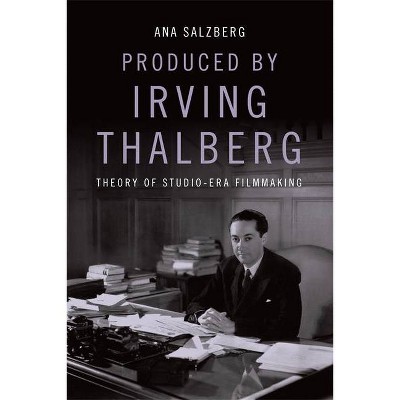
Produced by Irving Thalberg - by Ana Salzberg (Hardcover)
Similar Products

Products of same category from the store
All

Product info
<p/><br></br><p><b> About the Book </b></p></br></br><p>Drawing on archival sources, this is the first book to explore Thalberg's insights into casting, editing, story composition and the importance of the mass audience from a theoretical perspective. </p><p/><br></br><p><b> Book Synopsis </b></p></br></br><ul> <ul> <ul></ul></ul></ul> <p><strong>Explores Irving Thalberg's importance as not only a producer, but also a theorist of studio-era filmmaking</strong></p> <ul> <li>Offers a critical reappraisal of Thalberg's legacy</li> <li>Provides in-depth analyses of Thalberg's productions at MGM from 1924 through 1936</li> <li>Examines Thalberg's impact on film-historical turning points, including the transition to sound cinema and the development of the Production Code</li></ul> <p>Irving Thalberg was not just a critically important producer during Hollywood's Golden Age, but also an innovative theorist of studio-era filmmaking. Drawing on archival sources, this is the first book to explore Thalberg's insights into casting, editing, story composition and the importance of the mass audience from a theoretical perspective. It examines Thalberg's impact on film-historical turning points, such as the transition to sound cinema and the development of the Production Code, and features in-depth analyses of Thalberg's productions at MGM from 1924 to 1936, including films like <i>The Big Parade</i> (1925), <i>The Broadway Melody of 1929</i> (1929) and <i>Romeo and Juliet</i> (1936). The book argues that Thalberg's views represent a unified conceptual understanding of filmmaking - one that is still significant in the modern day.</p><p/><br></br><p><b> From the Back Cover </b></p></br></br>Irving Thalberg was not just a critically important producer during Hollywood's Golden Age, but also an innovative theorist of studio-era filmmaking. Drawing on archival sources, this is the first book to explore Thalberg's insights into casting, editing, story composition and the importance of the mass audience from a theoretical perspective. It examines Thalberg's impact on film-historical turning points, such as the transition to sound cinema and the development of the Production Code, and features in-depth analyses of Thalberg's productions at MGM from 1924 to 1936, including films like <i>The Big Parade</i> (1925), <i>The Broadway Melody of 1929</i> (1929) and <i>Romeo and Juliet</i> (1936). The book argues that Thalberg's views represent a unified conceptual understanding of filmmaking - one that is still significant in the modern day. Ana Salzberg is a lecturer in Film Studies and Visual Culture at the University of Dundee.<p/><br></br><p><b> About the Author </b></p></br></br><p>Dr Ana Salzberg is Lecturer in Film Studies and Visual Culture at the University of Dundee.<p>
Price History
Price Archive shows prices from various stores, lets you see history and find the cheapest. There is no actual sale on the website. For all support, inquiry and suggestion messages communication@pricearchive.us