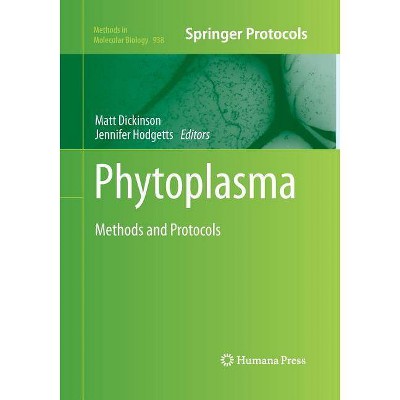
Phytoplasma - (Methods in Molecular Biology) by Matt Dickinson & Jennifer Hodgetts (Paperback)
Similar Products








Products of same category from the store
All









Product info
<p/><br></br><p><b> About the Book </b></p></br></br><p>This new addition to the Methods in Molecular Biology series covers a group of bacteria known for its destructive effects in a wide range of plant species, including crops in developing countries. This volume has the latest protocols and expert tips on method.</p><p/><br></br><p><b> Book Synopsis </b></p></br></br><p>1. The Phytoplasmas - An Introduction</p><p> Matt Dickinson, Melanie Tuffen, and Jennifer Hodgetts </p><p> </p><p>2. Techniques for the Maintenance and Propagation of Phytoplasmas in Glasshouse Collections of Catharanthus roseus</p><p> Jennifer Hodgetts, David Crossley, and Matt Dickinson</p><p> </p><p>3. Micropropagation and Maintenance of Phytoplasmas in Tissue Culture</p><p> Assunta Bertaccini, Samanta Paltrinieri, Marta Martini, Mara Tedeschi, and Nicoletta Contaldo </p><p> </p><p>4. Dodder Transmission of Phytoplasmas</p><p>Jaroslava Přibylová and Josef Spak</p><p> </p><p>5. Insect Maintenance and Transmission</p><p> Heather Kingdom</p><p> </p><p>6. Capturing Insect Vectors of Phytoplasmas</p><p> Phyllis Weintraub and Jürgen Gross</p><p> </p><p>7. Insect Vector Transmission Assays</p><p> Domenico Bosco and Rosemarie Tedeschi</p><p> </p><p>8. Molecular Identification of Phytoplasma Vector Species</p><p> Sabrina Bertin and Domenico Bosco </p><p> </p><p>9. Dienes' Staining and Light Microscopy for Phytoplasma Visualization</p><p> Rita Musetti </p><p> </p><p>10. DAPI Staining and Fluorescence Microscopy Techniques for Phytoplasmas</p><p> Nancy S. Andrade and Nolberto S. Arismendi </p><p> </p><p>11. Visualisation of Phytoplasmas using Electron Microscopy</p><p> B. Jean Devonshire</p><p> </p><p>12. Automated DNA Extraction for Large Numbers of Plant Samples</p><p> Natasa Mehle, Petra Nikolic, Matevz Rupar, Jana Boben, Maja Ravnikar, and Marina Dermastia</p><p> </p><p>13. DNA Extraction from Arborescent Monocots and How To Deal With Other Challenging Hosts</p><p> Nigel A. Harrison, Robert E. Davis, and Ericka E. Helmick </p><p> </p><p>14. Nested PCR and RFLP Analysis Based on the 16S rRNA Gene </p><p> Bojan Duduk, Samantha Paltrinieri, Ing Ming Lee, and Assunta Bertaccini</p><p> </p><p>15. PCR and RFLP Analyses Based on the Ribosomal Protein Operon</p><p> Marta Martini and Ing-Ming Lee</p><p> </p><p>16. Tuf and secY PCR Amplification and Genotyping of Phytoplasmas</p><p> Xavier Foissac, Jean-Luc Danet, Sylvie Malembic-Maher, Pascal Salar, Dana Safářová, Pavla Válová, and Milan Navrátil</p><p> </p><p>17. PCR Analysis of Phytoplasmas Based on the secA Gene</p><p> Matt Dickinson and Jennifer Hodgetts</p><p> </p><p>18. Single-Strand Conformation Polymorphism Analysis for Differentiating Phytoplasma Strains</p><p> Martina Seruga Music and Dijana Skoric</p><p> </p><p>19. Microarrays for Universal Detection and Identification of Phytoplasmas</p><p> Mogens Nicolaisen, Henriette Nyskjold, and Assunta Bertaccine</p><p> </p><p>20. T-RFLP for Detection and Identification of Phytoplasmas in Plants</p><p> Jennifer Hodgetts and Matt Dickinson</p><p> </p><p>21. Real-Time PCR for Universal Phytoplasma Detection and Quantification </p><p> Nynne Meyn Christensen, Henriette Nyskjold, and Mogens Nicolaisen</p><p> </p><p>22. A Real-Time PCR Detection System for the Bois Noir and Flavescence Dorée Phytoplasmas and Quantification of the Target DNA</p><p> Natasa Mehle, Nina Prezelj, Matjaz Hren, Jana Boben, Kristina Gruden, Maja Ravnikar, and Marina Dermastia</p><p> </p><p>23. Real-Time PCR for Specific Detection of Three Phytoplasmas from the Apple Proliferation Group</p><p> Natasa Mehle, Petra Nikolic, Kristina Gruden, Maja Ravnikar, and Marina Dermastia</p><p> </p><p>24. Reverse Transcription-PCR for Phytoplasma Detection Utilizing Crude Sap Extractions</p><p> Paola Margaria and Sabrina Palmano</p><p> </p><p>25. In-Field Diagnostics Using Loop-Mediated Isothermal Amplification (LAMP)</p><p> Jenny Tomlinson </p><p> </p><p>26. DNA Bar-Coding<p/><br></br><p><b> From the Back Cover </b></p></br></br><p>Phytoplasmas are a group of bacteria that are capable of multiplying and causing severe diseases in a wide range of plant species and are transported between plants by insect vectors in which the bacteria can also multiply. Phytoplasmas can cause serious and devastating problems for crop plants, especially in developing countries. <i>In Phytoplasmas: Methods and Protocols</i> experts in the field cover topics pertinent to scientists intending to develop a research program on phytoplasmas. The volume opens with an introductory chapter on the importance of phytoplasma diseases, followed by methods for detection and diagnosis as well as techniques for separating and classifying the phytoplasmas into their different taxonomic groups and subgroups. The final chapters cover methods for separating phytoplasma genomic and plasmid DNA from plant DNA for whole genome sequencing. Written in the successful <i>Methods in Molecular Biology(TM)</i> series format, chapters include introductions to their respective topics, lists of the necessary materials and reagents, step-by-step, readily reproducible protocols, and notes on troubleshooting and avoiding known pitfalls.</p><p> </p><p>Authoritative and easily accessible, <i>Phytoplasmas: Methods and Protocols</i> serves as an ideal guide to plant pathologists and molecular biologists aiming to set up a diagnostics facility for identifying the presence of these pathogens in plants or their insect vectors.</p>
Price History
Price Archive shows prices from various stores, lets you see history and find the cheapest. There is no actual sale on the website. For all support, inquiry and suggestion messages communication@pricearchive.us