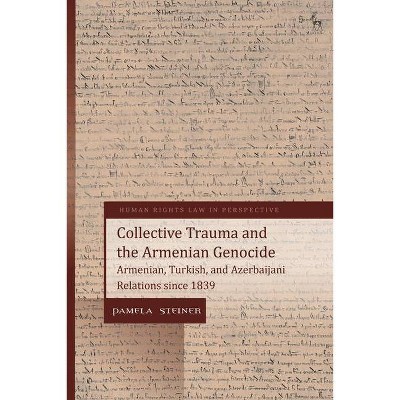
Collective Trauma and the Armenian Genocide - (Human Rights Law in Perspective) by Pamela Steiner (Hardcover)
Similar Products






Products of same category from the store
All









Product info
<p/><br></br><p><b> About the Book </b></p></br></br>"This book re-examines more than 100 years of destructive ethno-religious relations among Armenians, Turks, and Azerbaijanis through the novel lens of collective trauma. The author argues that a focus on embedded, transgenerational collective trauma is essential to achieving more trusting, productive, and stable relationships in this and similar contexts. The book takes a deep dive into history - analysing the traumatic events, examining and positing how they motivated the actions of key players (both victims and perpetrators), and revealing how profoundly these traumas continue to manifest today among the three peoples, stymying healing and inhibiting achievement of a basis for positive change. The author then proposes a bold new approach to "conflict resolution" as a complement to other perspectives, such as power-based analyses and international human rights. Addressing the psychological core of the conflict, the author argues that a focus on embedded collective trauma is essential in this and similar arenas"--<p/><br></br><p><b> Book Synopsis </b></p></br></br>In this pathbreaking study, Pamela Steiner deconstructs the psychological obstacles that have prevented peaceful settlements to longstanding issues.<br/><br/>The book re-examines more than 100 years of destructive ethno-religious relations among Armenians, Turks, and Azerbaijanis through the novel lens of collective trauma.<br/> <br/> The author argues that a focus on embedded, transgenerational collective trauma is essential to achieving more trusting, productive, and stable relationships in this and similar contexts. The book takes a deep dive into history - analysing the traumatic events, examining and positing how they motivated the actions of key players (both victims and perpetrators), and revealing how profoundly these traumas continue to manifest today among the three peoples, stymying healing and inhibiting achievement of a basis for positive change.<br/> <br/> The author then proposes a bold new approach to "conflict resolution" as a complement to other perspectives, such as power-based analyses and international human rights. Addressing the psychological core of the conflict, the author argues that a focus on embedded collective trauma is essential in this and similar arenas.<p/><br></br><p><b> Review Quotes </b></p></br></br><br>Collective trauma displays a compounding character that multiplies the impacts of its many dimensions and confounds the work of post-conflict healing. Pamela Steiner guides her readers through a trauma-informed understanding of what she calls the 'frozen ethno-national conflicts' that haunt modern Armenian, Turkish, and Azerbaijani relations. As the Great Granddaughter of Henry Morgenthau and an experienced facilitator of conflict resolution, Steiner adds personal and professional linkages to the case studies she addresses and the insights she offers regarding the complicating power that collective trauma adds to this complex history and situation.<br/>Henry F Knight, Former Director of the Cohen Center for Holocaust and Genocide Studies, Keene State College<br><br>Pam Steiner has written a pathbreaking study of collective trauma, providing a compelling analysis of a concept that scholars and practitioners often invoke but until now have not fully understood. By using extensive data from the Armenia-Turkey-Azerbaijan case, Dr Steiner demonstrates how crucial it is for effective policy prescription to be based on conflict analysis with deep historical and psychological elements. This book will revolutionize how conflict analysis is done, as it gives both urgency and guidance for why and how a 'walk through history' must be conducted.<br/>Eileen Babbitt, Professor of Practice of International Conflict Management, The Fletcher School of Law and Diplomacy, Tufts University<br><br>The author's statement that 'I decided to write this book when I believed I had a fresh and useful perspective to share, 'perfectly encapsulates the importance and value of the book you are holding in your hands. Steiner examines, perhaps for the first time, the role collective trauma played among three peoples - Armenians, Azerbaijanis and Turks - and in their mutual relations. She shows how this collective trauma and those that followed are not only the product of their yet unresolved conflicts, but also serve as major stumbling blocks for a better future in the region. For them, the Armenian genocide is like an inescapable psychic maze of trauma, one in which they are trapped and unable to see beyond. If there is indeed a way out of this labyrinth, Steiner's work will serve as a torch, lighting the way.<br/>Taner Akcam, Professor of History, Clark University<br><p/><br></br><p><b> About the Author </b></p></br></br>Pamela Steiner is Senior Fellow, FXB Center for Health and Human Rights, Harvard University.
Price History
Cheapest price in the interval: 120.99 on November 8, 2021
Most expensive price in the interval: 120.99 on December 20, 2021
Price Archive shows prices from various stores, lets you see history and find the cheapest. There is no actual sale on the website. For all support, inquiry and suggestion messages communication@pricearchive.us