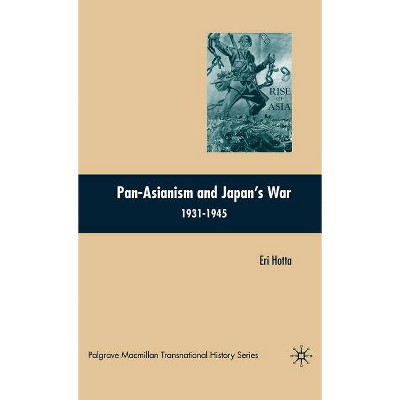
Pan-Asianism and Japan's War 1931-1945 - (Palgrave MacMillan Transnational History) by E Hotta (Hardcover)
Similar Products

Products of same category from the store
All


Product info
<p/><br></br><p><b> About the Book </b></p></br></br>The focus of this book is on Pan-Asianism as a propeller behind Japan's expansionist policies from the Manchurian Incident in 1931 until the end of the Pacific War in 1945.<p/><br></br><p><b> Book Synopsis </b></p></br></br>The book sheds light on the critical importance of Pan-Asianism in Japanese imperialism. Pan-Asianism was a cultural as well as political ideology that promoted Asian unity and recognition. The focus of this book is on Pan-Asianism as a propeller behind Japan's expansionist policies from the Manchurian Incident in 1931 until the end of the Pacific War in 1945.<p/><br></br><p><b> Review Quotes </b></p></br></br><br><p>'The most comprehensive treatment of this topic in English . . . This book should be essential reading for both undergraduate and graduate level courses on international affairs and Asian politics, as well as histories of imperialism and colonization.' - American Historical Review</p> <p>'Hotta extensively documents the continuing presence of Pan-Asianism in Japan's policy making. This, by taking up the challenge of accounting for the ideological aspect of Japan's war, the book offers a new insight into an often fragmented history of Japan's Fifteen Years' War.' - The Journal of Asian Studies</p> <p>'Richly nuanced . . . Hotta has presented a study that grants Pan-Asianism a breadth that has not been discovered to date . . . Transnational comparisons with pan-Slavic and pan-Islamic movements lead to a multifaceted approach.' -Geschichte.Transnational</p> <p>'Pan-Asianism in the wartime Japanese empire is often dismissed as pure opportunism, a cynical hoax designed to justify the conquest of Asia. Hotta's original, superbly researched study demonstrates instead the profound historical roots of Japanese Pan-Asianism. This ideology significantly shaped Japanese leaders' decisions to wage war against China and the Anglo-American powers, overpowering the more realistic assessments of some strategists. The book stands as a major contribution to the literature on Japanese history and international relations.' - Sheldon Garon, author of Molding Japanese Minds: The State in Everyday Life</p> <p>'This book provides a comprehensive and richly-detailed exposition of the ideology at the core of Japan's foreign policy from 1931 - 1945, Pan-Asianism...Hotta not only provides an enlightening study of a relatively neglected aspect of Japan's war in Asia, but also sheds light more generally on the importance of ideational factors in international politics. She does so in a masterful and highly readable way.' - Caroline Rose, Asian Affairs</p><br><p/><br></br><p><b> About the Author </b></p></br></br>ERI HOTTA taught at Oxford University, UK from 2001-2005.
Price History
Price Archive shows prices from various stores, lets you see history and find the cheapest. There is no actual sale on the website. For all support, inquiry and suggestion messages communication@pricearchive.us