Cheap Meat - by Deborah Gewertz & Frederick Errington (Paperback)
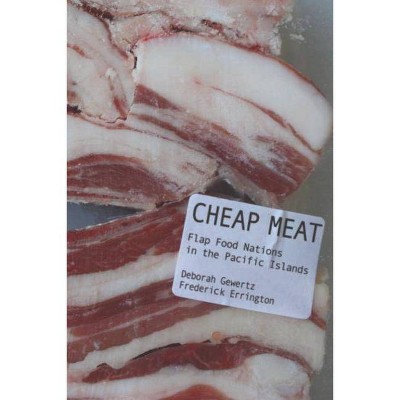
Similar Products





Products of same category from the store
All





Product info
<p/><br></br><p><b> About the Book </b></p></br></br>"Gewertz and Errington unpack the aspirations and anxieties, calculations and controversies that inhabit an inexpensive cut of fatty meat. Following the trail of sheep bellies from slaughterhouses in Australia and New Zealand to the plates of Pacific Islanders, they evenhandedly map the divergent perspectives of commercial traders, government officials, and ordinary consumers acting within a contested material and moral economy. "Cheap Meat" provides a startling view of how global food markets fashion the bodies and identities of people everywhere."--Robert J. Foster, author of "Coca-Globalization: Following Soft Drinks from New York to New Guinea" <BR>""Cheap Meat "is a compelling example of how ethnography concerned with Oceania can elucidate broader questions in anthropology and the social sciences in general. Gewertz and Errington show the complexity of globalization by focusing on the most unlikely commodity. This work at once demonstrates how unfettered capitalism is able to use global circulation to literally convert one person's trash to another's treasure and how resilient Pacific Islanders refashion Western commodities to their own ends."--Paige West, Curator for the Pacific American Museum of Natural History<p/><br></br><p><b> Book Synopsis </b></p></br></br><i>Cheap Meat</i> follows the controversial trade in inexpensive fatty cuts of lamb or mutton, called "flaps," from the farms of New Zealand and Australia to their primary markets in the Pacific islands of Papua New Guinea, Tonga, and Fiji. Deborah Gewertz and Frederick Errington address the evolution of the meat trade itself along with the changing practices of exchange in Papua New Guinea. They show that flaps-which are taken from the animals' bellies and are often 50 percent fat-are not mere market transactions but evidence of the social nature of nutrition policies, illustrating and reinforcing Pacific Islanders' presumed second-class status relative to the white populations of Australia and New Zealand.<p/><br></br><p><b> From the Back Cover </b></p></br></br>"Gewertz and Errington unpack the aspirations and anxieties, calculations and controversies that inhabit an inexpensive cut of fatty meat. Following the trail of sheep bellies from slaughterhouses in Australia and New Zealand to the plates of Pacific Islanders, they evenhandedly map the divergent perspectives of commercial traders, government officials, and ordinary consumers acting within a contested material and moral economy. <i>Cheap Meat</i> provides a startling view of how global food markets fashion the bodies and identities of people everywhere."--Robert J. Foster, author of <i>Coca-Globalization: Following Soft Drinks from New York to New Guinea</i><br /><br />"<i>Cheap Meat </i>is a compelling example of how ethnography concerned with Oceania can elucidate broader questions in anthropology and the social sciences in general. Gewertz and Errington show the complexity of globalization by focusing on the most unlikely commodity. This work at once demonstrates how unfettered capitalism is able to use global circulation to literally convert one person's trash to another's treasure and how resilient Pacific Islanders refashion Western commodities to their own ends."--Paige West, Curator for the Pacific American Museum of Natural History<p/><br></br><p><b> Review Quotes </b></p></br></br><br>"A fascinating study about a distasteful topic."--Eric K. Silverman "Pacific Affairs" (6/29/2011 12:00:00 AM)<br><br>"An engaging narrative. . . . Will be of interest to a broad audience."--Geoffrey C. Marks "American Journal Of Human Biology" (6/29/2011 12:00:00 AM)<br><br>"Could easily become a food studies classic. . . . A compelling and informative read."-- "Material World" (7/6/2010 12:00:00 AM)<br><br>"Valuable book for a range of academic interests including human rights, photography and journalism, and the history of South Africa and apartheid."--Paul Lowe "Times Higher Education" (7/22/2010 12:00:00 AM)<br><p/><br></br><p><b> About the Author </b></p></br></br><b>Deborah Gewertz</b> is G. Henry Whitcomb 1874 Professor of Anthropology and Chair of the Department of Anthropology and Sociology at Amherst College. <b>Frederick Errington</b> is Distinguished Professor of Anthropology at Trinity College, Hartford, Connecticut. Among their many books are <i>Emerging Class in Papua New Guinea: The Telling of Difference</i> and <i>Yali's Question: Sugar, Culture, and History</i>.
Price History
Cheapest price in the interval: 29.99 on October 22, 2021
Most expensive price in the interval: 29.99 on November 8, 2021
Price Archive shows prices from various stores, lets you see history and find the cheapest. There is no actual sale on the website. For all support, inquiry and suggestion messages communication@pricearchive.us