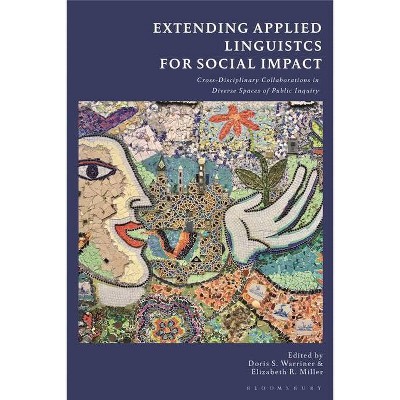
Extending Applied Linguistics for Social Impact - by Doris S Warriner & Elizabeth R Miller (Hardcover)
Similar Products


Products of same category from the store
All






Product info
<p/><br></br><p><b> About the Book </b></p></br></br>"Despite the commitment of applied linguistics research to investigate language use in real-world contexts, applied linguists have struggled to make their work accessible and relevant outside academia. Acknowledging that the field has not yet reached its full potential, this book demonstrates how applied linguists can utilize their knowledge and methods to explore contemporary social problems beyond the borders of their own discipline, to have a valuable impact on other fields, local communities and the general public. Drawing on theories, methods and methodologies in applied linguistics, chapters address pressing concerns such as equal access to education for immigrants, science education in preschool dual-language contexts, healthcare delivery to refugee families, gendered language in disability studies and social sustainability initiatives. The diversity of research contexts shows how the work of applied linguists can have tangible social impact and help to influence meaningful change. By increasing public awareness of language-related issues affecting society, this book responds to a vital gap in the field and marks and important step towards a more socially-engaged, accessible and inclusive approach to applied linguistics"--<p/><br></br><p><b> Book Synopsis </b></p></br></br>Drawing on--but also extending--the theories and methods of applied linguistics, this book demonstrates how scholars of language might work together and with non-language specialists to address pressing concerns and issues of our time. Chapters explore efforts to recognize the legitimacy of stigmatized language varieties in public and institutional domains, museum-based science education for linguistically diverse children, how corpus analysis might illuminate the tension between the language choices and commitments of certain leaders, the embodied and artistic forms of meaning-making that challenge norms of Whiteness, and the transformative power of translanguaging in community-based theater. <br/> <br/>In addition, the volume demonstrates ways to enhance equity in healthcare delivery for immigrant families, examines the experiences of cultural health navigators working with refugee-background families, and highlights the value of raising public awareness of language issues related to social justice. These accounts show that applied linguists stand ready to interface with other scholars, other institutions, and the public to make socially-engaged and impactful contributions to the study of language, society, education, and access. Collectively, the authors respond to an important gap in the field and take a significant step towards a more socially-just, accessible, and inclusive approach to applied linguistics.<p/><br></br><p><b> Review Quotes </b></p></br></br><br>A beautiful book. It shows us the courageous and tenacious work of linguists and language specialists reaching out to engage with others around public issues and advocacy. From addressing local health crises for immigrant communities, to reforming US census categories, to enabling multilingualism in art and theatre workshops and much more, why else do research, if not to touch lives?<br/>Nancy H. Hornberger, Professor Emerita, University of Pennsylvania, USA<br><br>At last! This volume offers answers for those wondering how our applied linguistics practice can address injustices, shift public policy, transform conditions for minoritized people and local communities-change the world! Offering concrete, detailed examples, these authors reveal the possibilities, beauty, and richness of public- and community-engaged work without glossing over its messiness. Rymes' <i>Afterword</i> dazzles.<br/>Suhanthie Motha, Associate Professor, University of Washington, USA<br><br>This highly engaging, beautifully crafted volume advances our understanding of what it means to authentically 'apply' 'applied linguistics'. Chapters highlight how (and why) applied linguistics scholars can (and should) do more to make our findings relevant, to more meaningfully partner with communities, and to more fully engage with the world around us.<br/>Kendall A. King, Professor of Second Language Education, University of Minnesota, USA<br><p/><br></br><p><b> About the Author </b></p></br></br><p><b>Doris S. Warriner</b> is Professor in the Department of English at Arizona State University, USA. <p/><b>Elizabeth R. Miller </b>is Professor in the Department of English at the University of North Carolina Charlotte, USA.</p>
Price History
Price Archive shows prices from various stores, lets you see history and find the cheapest. There is no actual sale on the website. For all support, inquiry and suggestion messages communication@pricearchive.us