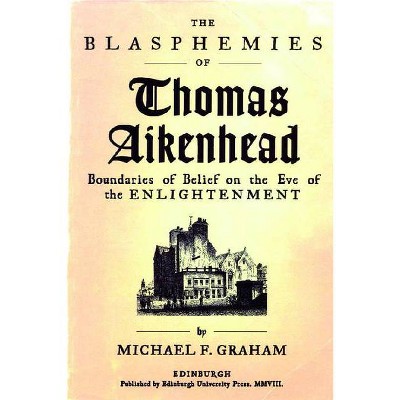
The Blasphemies of Thomas Aikenhead - by Michael F Graham (Paperback)
Similar Products





Products of same category from the store
All


Product info
<p/><br></br><p><b> About the Book </b></p></br></br>Thomas Aikenhead was an Edinburgh University student and, in 1697, the last person executed for blasphemy in Britain. This examination of the media event that was his trial opens a window onto the clash of intellects and cultures that took place in late seventeenth-century Scotland as it stood in transition between Reformation and Enlightenment.<p/><br></br><p><b> Book Synopsis </b></p></br></br><p>Thomas Aikenhead, a sometime University of Edinburgh student, was in 1697 the last person executed for blasphemy in Britain.</p> <p>Michael Graham uses the case to open a window into the world of late seventeenth-century Edinburgh and Scotland, exploring the core historical themes in a country in transition from confessional Reformation to polite, literary Enlightenment.</p> <p>Graham traces the roots of the Aikenhead case and the law of blasphemy which was evolving in response to new intellectual currents of biblical criticism and deism. He analyzes Aikenhead's trial and the Scottish government's decision to uphold the sentence of hanging and details the debates surrounding the execution which were carried out in print media across Scotland and England. Aikenhead's case grew into a media event which highlighted starkly the intellectual and cultural divisions dominating late seventeenth-century Britain. <br></p><p/><br></br><p><b> From the Back Cover </b></p></br></br>This is the first modern book-length study of the case of Thomas Aikenhead, the sometime University of Edinburgh student who in 1697 earned the unfortunate distinction of being the last person executed for blasphemy in Britain. Taking a micro-historical approach, Michael Graham uses the Aikenhead case to open a window into the world of late seventeenth-century Edinburgh and Scotland. This book brings together many of the critical themes in Scottish and British history in a period of transition from the confessional era of the Reformation - which emphasised the defence of orthodox belief - to the more open civil society and polite, literary world of the Enlightenement, of which Edinburgh would become a major centre. Graham traces the roots of the Aikenhead case in seventeenth-century Scotland and the law of blasphemy which was evolving in response to the new intellectual currents of biblical criticism and deism. He analyzes Aikenhead's trial and the Scottish government's decision to uphold the sentence of hanging. Finally, he details the debate engendered by the execution, carried out in a public sphere of print media encompassing both Scotland and England. Aikenhead's case became a media event which highlighted the intellectual and cultural divisions within Britain at the end of the seventeenth century. Michael F. Graham is Professor of History at the University of Akron, Ohio<p/><br></br><p><b> Review Quotes </b></p></br></br><br>'Michael F Graham uses the "microhistorical method ... to give us the best account yet of Aikenhead's life and hanging. It is painstaking research - all those fugitive legal documents and trawling through ancient library indexes - but it adds up to a rounded and enthralling if necessarily incomplete and speculative picture'--Stuart Kelly "The Scotsman"<br><br>Aikenhead's execution is considered a milestone on Scotland's dark road to the Enlightenment and Graham shows us with vividness and some effective dramatic timing, the worst that can happen when self-righteousness and political expediency join forces.--Dilys Rose "Edinburgh Review"<br><br>Michael F. Graham tackles the infamous Aikenhead case with a microhistorical approach. He examines Aikenhead's case in the context of the social history of 1690s Edinburgh and explains how a student became a scapegoat... Graham makes a convincing case that social factors influenced the fate of Thomas Aikenhead.--Karen Baston "Early Modern Intelligencer"<br><br>This is detailed and archivally informed historical writing - exploiting parish, judicial, ecclesiastical and private papers Graham delivers a textured sense of the tense atmosphere riven by a bustling and intellectually robust university and the assumptions of a civic society which assumed the rightness of divine punishment for public sins... An excellent contribution to contextualising both the possibilities and consequences of articulating dissident ideas in an anxious confessional culture.--Justin Champion, Royal Holloway, University of London "Reviews in History"<br><p/><br></br><p><b> About the Author </b></p></br></br><p>Michael F. Graham is Professor of History and sometime Director of the Humanities in the Western Tradition programme at the University of Akron, Ohio. His previous publications include 'The Uses of Reform: 'Godly Discipline' and Popular Behaviour in Scotland and Beyond, 1560-1610' (1996), which was awarded the Roland Bainton Prize by the Sixteenth Century Studies Conference. His research focuses on the religious, cultural and social history of early modern Britain.<p>
Price History
Price Archive shows prices from various stores, lets you see history and find the cheapest. There is no actual sale on the website. For all support, inquiry and suggestion messages communication@pricearchive.us