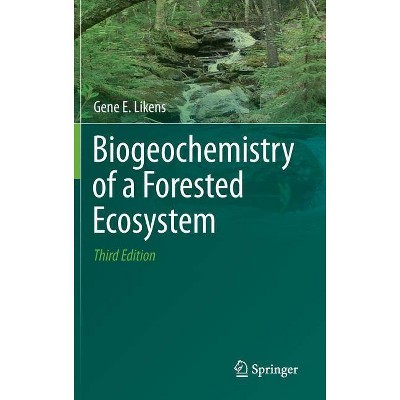
Biogeochemistry of a Forested Ecosystem - 3rd Edition by Gene E Likens (Hardcover)
Similar Products








Products of same category from the store
All







Product info
<p/><br></br><p><b> About the Book </b></p></br></br>This book describes the integration of several different approaches to examine questions regarding the function of interesting plant metabolites. This new edition generates new syntheses and conclusions about the biogeochemistry of the Hubbard Brook Valley.<p/><br></br><p><b> Book Synopsis </b></p></br></br>1 Ecosystem Analysis Small Watershed Approach The Hubbard Brook Ecosystem Location Climate Area, Topography, and Aspect Geology Soils Vegetation and Fauna Drainage Streams Concluding Thoughts 2 Hydrology The Water-Year Precipitation Streamflow and Evapotranspiration Deep Seepage Representativeness of the Hydrology of the Hubbard Brook Experimental Forest for Northern New England 3 Chemistry Precipitation Chemistry Annual Volume-Weighted Concentrations Origin of Ions in Bulk Precipitation Dry Deposition Elevational Effects Acid Precipitation Acid rain and base cation depletion Some charge equivalence changes and biotic responses: Headwater results scaled to Hubbard Brook and Beyond: Snow and Snowpack Chemistry Dilution and Effect of Acid Rain on Baselines Impact of acid rain on accumulation of forest biomass How has the forest ecosystem in W6, the reference watershed, responded to acid rain? Trace Metals Throughfall and Stemflow Streamwater Chemistry Concentrations of Dissolved Substances Valleywide Streamwater Chemistry - A Synoptic View Seasonal Variations in Bulk Precipitation and Streamwater Concentrations Long-Term Trends in Bulk Precipitation and Streamwater Chemistry 4 Input-Output Budgets Mass Meteorologic Input of Dissolved Substances Annual Variation in Net Hydrological Budgets Some Examples of Important Components of Input-Output Budgets Nitrogen Chlorine Sulfur Dissolved Silica Input-Output Budgets: Summary Monthly Variations Output Consistently Greater Than Input Input Consistently Greater Than Output Crossover Patterns Relationship of Annual Mass Output of Dissolved Substances to Annual Streamflow Annual Variation in Mass Output of Dissolved Substances Particulate Matter Measurement of mass output Annual loss Seasonal variation in erodibility Particulate Matter Versus Dissolved Substance Export The Role of Debris Avalanches in Landscape Denudation Long-Term Changes in Input/Output Budgets 5 Weathering Source of Hydrogen Ion in the Weathering Reaction Carbon Nitrogen Sulfur Estimates of Ecosystem Weathering Flux Net Soil Release 6 Nutrient Cycles and Mass Balances The Calcium Cycle The Potassium Cycle The Sulfur Cycle Nutrient Cycle Relationships at the HBEF Annual Watershed-Ecosystem Mass Balances ("Budgets") Calcium Sodium Potassium Sulfur Nitrogen Nitrogen retention in forested watershed-ecosystems Chlorine 7 The Northern Hardwood Ecosystem in the Hubbard Brook Valley in Relation to Other Forest Ecosystems 8 Summary Discussion and Conclusions Epilog Odyssey<p/><br></br><p><b> From the Back Cover </b></p></br></br><p>The pioneering watershed-ecosystem studies initiated at the Hubbard Brook Experimental Forest in 1963 underpin this thoroughly updated and in-depth analysis of the biogeochemistry of a forested ecosystem in the White Mountains of New Hampshire. In a novel synthesis of almost 50 years, this third Edition summarizes and interprets these unique data on precipitation and streamwater chemistry, hydrology, and weathering and also considers the role of atmospheric gases and particles as they flow into and out of the ecosystem. Long-term, complete annual budgets are presented for many critical elements in the ecosystem, providing for the first time a comparative view of biogeochemical dynamics in the Hubbard Brook watershed-ecosystems. These results show how an ecosystem is connected to global biogeochemical cycles by its inputs and outputs of water and nutrients. </p><p> </p><p>About the Author: </p><p>Gene E. Likens is a co-founder of the Hubbard Brook Ecosystem Study and Founder and President Emeritus of the Cary Institute of Ecosystem Studies in Millbrook, New York. Likens was awarded the National Medal of Science in 2001, largely for his work at Hubbard Brook.</p><p><p/><br></br><p><b> Review Quotes </b></p></br></br><br><p>From the book reviews: </p><p>"This third edition ... continues the release of data and interpretations related to the Hubbard Brook Experimental Forest (HBEF) in New Hampshire. ... The HBEF system is a well-circumscribed site, providing a detailed large-scale area where changes in the availability, cycling, and fluxes of chemical elements and other matter can be monitored. ... Summing Up: Recommended. Upper-division undergraduates and above." (D. H. Pfister, Choice, Vol. 51 (11), July, 2014)</p><br><p/><br></br><p><b> About the Author </b></p></br></br>Dr. Likens' research focuses on the ecology and biogeochemistry of forest and aquatic ecosystems, primarily through long-term studies at the Hubbard Brook Experimental Forest, in the White Mountains of New Hampshire. He was the co-founder of the Hubbard Brook Ecosystem Study in 1963, which has shed light on critical links between ecosystem function and land-use practices. He and his colleagues were the first scientists to discover acid rain in North America and to document the link between the combustion of fossil fuels and an increase in the acidity of precipitation. His findings have influenced politicians and policy makers, guided and motivated scientific studies, and increased public awareness of human-accelerated environmental change.
Price History
Price Archive shows prices from various stores, lets you see history and find the cheapest. There is no actual sale on the website. For all support, inquiry and suggestion messages communication@pricearchive.us