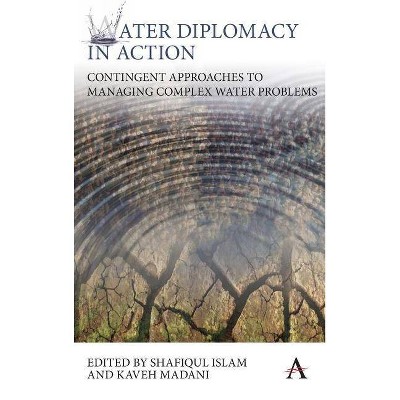
Water Diplomacy in Action - by Shafiqul Islam & Kaveh Madani (Hardcover)
Similar Products









Products of same category from the store
All









Product info
<p/><br></br><p><b> About the Book </b></p></br></br><p>Rooted in the ideas of complexity science and mutual gains negotiation, this volume shows why traditional systems engineering approaches will not work for complex water problems and what emerging tools and techniques are needed to resolve them. This collection successfully synthesizes insights from theory and practice to advocate for contingent and adaptive management using a water diplomacy framework. </p><p/><br></br><p><b> Book Synopsis </b></p></br></br><p>Today we face an incredibly complex array of interconnected water issues that cross multiple boundaries: Is water a property or a human right? How do we prioritize between economic utility and environmental sustainability? Do fish have more rights to water than irrigated grain? Can we reconcile competing cultural and religious values associated with water? How much water do people actually need? These questions share two key defining characteristics: (a) competing values, interests and information to frame the problem; and (b) differing views - of how to resolve a problem - are related more to uncertainty and ambiguity of perception than accuracy of scientific information. </p> <p>These problems - known as complex problems - are ill-defined, ambiguous, and often associated with strong moral, political and professional values and issues. For complex water problems, certainty of solutions and degree of consensus varies widely. In fact, there is often little consensus about what the problem is, let alone how to resolve it. Furthermore, complex problems are constantly changing because of interactions among the natural, societal and political forces involved. The nature of complexity is contingent on a variety of contextual characteristics of the interactions among variables, processes, actors, and institutions. Understanding interactions and feedback loops between and within human and natural systems is critical for managing complex water problems. [NP] This edited volume synthesizes insights from theory and practice to address complex water problems through contingent and adaptive management using water diplomacy framework (WDF). This emerging framework diagnoses water problems, identifies intervention points, and proposes sustainable solutions that are sensitive to diverse viewpoints and uncertainty as well as changing and competing needs. The WDF actively seeks value-creation opportunities by blending science, policy, and politics through a contingent negotiated approach.</p><p/><br></br><p><b> About the Author </b></p></br></br><p>Shafiqul Islam is a professor of civil and environmental engineering and professor of water diplomacy at the Fletcher School of Law and Diplomacy, Tufts University. He is the director of the Water Diplomacy Program and the 2016 recipient of the Prince Sultan Bin Abdulaziz International Water Prize for Creativity. </p> <p>Kaveh Madani is a reader in systems analysis and policy at the Centre for Environmental Policy of the Imperial College London. He is one of the four recipients of the Arne Richter Award for Outstanding Young Scientists in 2016 for his fundamental contributions to integrating game-theory and decision-analysis into water management models.</p>
Price History
Price Archive shows prices from various stores, lets you see history and find the cheapest. There is no actual sale on the website. For all support, inquiry and suggestion messages communication@pricearchive.us