The econocracy - (Manchester Capitalism) by Joe Earle & Cahal Moran & Zach Ward-Perkins (Hardcover)
Similar Products

Products of same category from the store
All

Product info
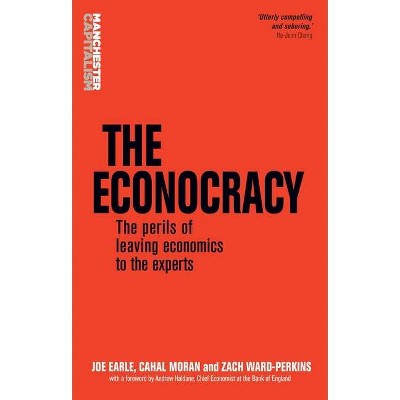
<p/><br></br><p><b> About the Book </b></p></br></br>A particular, narrow way of thinking about the economy is dominant in society today. This book explores how this came to be, why the system cannot continue and how to build a better future.<p/><br></br><p><b> Book Synopsis </b></p></br></br><p>One hundred years ago the idea of 'the economy' did not exist. Now, improving the economy has come to be seen as the single most important task facing modern societies. Politics and policymaking are conducted in the language of economics and economic logic shapes how political issues are thought about and addressed. The result is that the majority of citizens, who cannot speak this specialised language, find themselves locked out of the system while political decisions are devolved to experts. <em>The econocracy</em> explores how this way of thinking about economies and economics has come to dominate - and the damaging effects its domination has caused. We have put experts in charge but those experts are not fit for purpose. <br /> <br /> A growing movement is arguing that we need to reshape the relationship between society and its economic experts. Across the world, students - the experts of the future - are rebelling against an education system that is broken. From three members of this movement comes a book that seeks to open up the black box of economic decision-making to public scrutiny, exposing how a particular narrow, inward-looking form of economics has come to dominate in universities across the UK and has thus shaped our very understanding of the economy. In<em>The econocracy</em> they document the weaknesses of this form of economics and how it has failed to address many important issues - including financial stability, environmental sustainability and inequality - and set out a vision for bringing economic discussion and decision-making back into the public sphere so that societies of the future can flourish.</p><p/><br></br><p><b> From the Back Cover </b></p></br></br>One hundred years ago the idea of 'the economy' did not exist. Now, improving the economy has come to be seen as the single most important task facing modern societies. Politics and policymaking are conducted in the language of economics and economic logic shapes how political issues are thought about and addressed. The result is that the majority of citizens, who cannot speak this specialised language, find themselves locked out of the system while political decisions are devolved to experts. <i>The econocracy</i> explores how this way of thinking about economies and economics has come to dominate - and the damaging effects its domination has caused. We have put experts in charge but those experts are not fit for purpose. A growing movement is arguing that we need to reshape the relationship between society and its economic experts. Across the world, students - the experts of the future - are rebelling against an education system that is broken. From three members of this movement comes a book that seeks to open up the black box of economic decision-making to public scrutiny, exposing how a particular narrow, inward-looking form of economics has come to dominate in universities across the UK and has thus shaped our very understanding of the economy. In <i>The econocracy</i> they document the weaknesses of this form of economics and how it has failed to address many important issues - including financial stability, environmental sustainability and inequality - and set out a vision for bringing economic discussion and decision-making back into the public sphere so that societies of the future can flourish.<p/><br></br><p><b> Review Quotes </b></p></br></br><br><br>'Economics has become the organising principle, the reigning ideology, and even the new religion of our time. And this body of knowledge is controlled by a selective priesthood trained in a very particular type of economics - that is, Neoclassical economics. In this penetrating analysis, based on<br>very sophisticated theoretical reflections and highly original empirical work, the authors show how the rule by this priesthood and its disciples is strangling our economies and societies and how we can change this situation. It is a damning indictment for the economics profession that it has taken<br>young people barely out of university to provide this analysis. Utterly compelling and sobering.' - Ha-Joon Chang, Reader in Political Economy of Development at the University of Cambridge and Author of Economics: The User's Guide<p></p><br>'A rousing wake-up call to the economics profession to re-think its mission in society, from a collective of dissident graduate students. Their double argument is that the 'econocracy' of economists and economic institutions which has taken charge of our future is not fit for purpose, and, in any<br>case, it contradicts the idea of democratic control. So the problem has to be tackled at both ends: creating a different kind of economics, and restoring the accountability of the experts to the citizens. The huge nature of the challenge does not daunt this enterprising group, whose technically<br>assured, well-argued, and informative book must be read as a manifesto of what they hope will grow into a new social reform movement.' - Lord Robert Skidelsky, Professor Emeritus of Political Economy at Warwick University and Fellow of the British Academy in History and Economics<p></p><br>'If war is too important to be left to the generals, so is the economy too important to be left to narrowly trained economists. Yet, as this book shows, such economists are precisely what we are getting from our leading universities. Given the role economists play in our society, we need them to be<br>much more than adepts in manipulating equations based on unrealistic assumptions. This book demonstrates just why that matters and offers thought-provoking ideas on how to go about it.' - Martin Wolf, Associate Editor and Chief Economics Commentator at the Financial Times<p></p><br>'An interesting and highly pertinent book.' - Noam Chomsky<p></p><br>'Economics, as practiced in university economics departments, regurgitated by policy makers, and summarised in the mainstream media, has become a form of propaganda. This superb book explains how: dangerous ideology is hidden inside a mathematical wrapper; controversial policies are presented as<br>'proven' by the models of economic 'science'. This book is essential reading for anyone who wants to know about the con - that includes everyone concerned with the future of democracy.' - Jonathan Aldred, Author of The Sceptical Economist<p></p><br>'Historians, one day, will study the mesmeric capacity of economic doctrine to override the public's faculty of rational judgement in favour of an unquestioning faith in the experts, in the face of the overwhelming evidence that they have got absolutely everything completely wrong. This research<br>will engender the same sense of disbelief, I am convinced, that we feel today for the high mediaeval dogma that the sun must go around the earth because God ordained it so. This book will then be recognised as a turning point. It is an eloquent, quietly passionate, but above all knowledgeable<br>statement of the simple fact that the emperor is naked, rounded off by a remarkably clear prescription for doing without tailors. Do not miss it.' - Alan Freeman, Visiting Professor at London Metropolitan University and Research Fellow of Queensland University of Technology, Australia<p></p><br>'This superbly written and scholarly work makes a strong case for wresting control of economic and political dialogue back from the pseudo-profession of academic economists and returning it to the body politic. Its authors are student economists who, writing after the financial crisis that<br>mainstream economists didn't see coming, have approached their topic with refreshing scepticism, and a wisdom far beyond their years. This is an excellent read that I strongly recommend.' - Steve Keen, Head of the School Of Economics, History & Politics at Kingston University, London<p></p><br>'This is an impressive book of admirable scope and ambition.' - Andrew Mearman, Leeds University Business School, International Review of Economics Education<p></p><br>'Is economics too important to be left to the economists? The authors marshal a powerful case against economics as it often is, and set out a positive vision of economics as it might be, a public interest economics which enables citizens to understand the economy better and participate more fully in<br>the decisions which affect all our futures. An important and timely book.' - Andrew Gamble, Professor of Politics at the University of Cambridge and Joint Editor of New Political Economy and the Political Quarterlya<p></p><br>'Economics is a subject of importance to all citizens, yet many economists have been unwilling to engage in the public debate made essential by the financial crisis and its consequences. This book is a provocative but welcome contribution to the democratic conversation that has to take place about<br>the role of economics in public policy, and the need for the subject to be accessible to everyone. Many economists will not agree with all of the book's analysis but they certainly should not ignore it.' - Diane Coyle, Visiting Professor at the University of Manchester's Institute for Political and<br>Economic Governance and Managing Director of Enlightenment Economics<p></p><br>The high priests of economics still hold power, but they no longer have legitimacy. In proving so resistant to serious reform, they have sent the message to a sceptical public that they are unreformable. Which makes The Econocracy a case study for the question we should all be asking since the<br>crash: how, after all that, have the elites - in Westminster, in the City, in economics - stayed in charge? - The Guardian Book of the Day 09/02/2017 <br><p></p><br>Like Walt Whitman, The Econocracy contains multitudes. <br>Martin Sandbu, The Financial Times, 24/02/2017 <br><p></p><br>This slim book manages to pack in a concise and well-researched critique of modern economics and how it is taught in universities as well as the broader issue of public engagement with economics as part of the democratic process. Written in the wake of the Brexit referendum but before the<br>surprising success of Donald Trump, this book is a timely warning of what can happen when economists, policymakers and the public can't find common ground. - Maxine Montaigne, LSE Review of books <br><p></p><br>...an interesting volume for anyone who wants to rethink their approach to the economical language. - Market Plus, the Swiss Financial Channel - April 2017 <br><p></p><br><br><p/><br></br><p><b> About the Author </b></p></br></br><br>Joe Earle, Cahal Moran and Zach Ward-Perkins are founding members of the Post-Crash Economics Society at the University of Manchester<br>
Price History
Price Archive shows prices from various stores, lets you see history and find the cheapest. There is no actual sale on the website. For all support, inquiry and suggestion messages communication@pricearchive.us