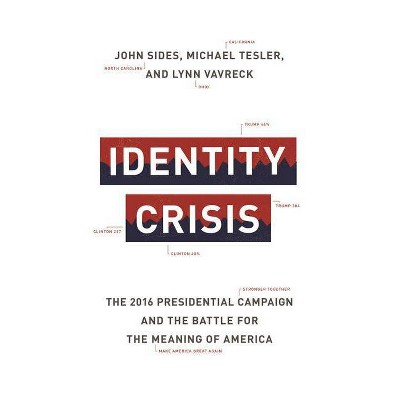
Identity Crisis - by John Sides & Michael Tesler & Lynn Vavreck (Hardcover)
Similar Products




Products of same category from the store
All






Product info
<p/><br></br><p><b> Book Synopsis </b></p></br></br><p><b>A gripping, in-depth account of the 2016 presidential election that explains Donald Trump's historic victory</b> <p/>Donald Trump's election victory stunned the world. How did he pull it off? Was it his appeal to alienated voters in the battleground states? Was it Hillary Clinton and the scandals associated with her long career in politics? Were key factors already in place before the nominees were even chosen? <i>Identity Crisis</i> provides a gripping account of the campaign that appeared to break all the political rules--but in fact didn't. <p/><i>Identity Crisis</i> takes readers from the bruising primaries to an election night whose outcome defied the predictions of the pollsters and pundits. The book shows how fundamental characteristics of the nation and its politics--the state of the economy, the Obama presidency, and the demographics of the political parties--combined with the candidates' personalities and rhetoric to produce one of the most unexpected presidencies in history. Early on, the fundamental characteristics predicted an extremely close election. And even though Trump's many controversies helped Clinton maintain a comfortable lead for most of the campaign, the prediction of a close election became reality when Americans cast their votes. <p/><i>Identity Crisis</i> reveals how Trump's victory was foreshadowed by changes in the Democratic and Republican coalitions that were driven by people's racial and ethnic identities. The campaign then reinforced and exacerbated those cleavages as it focused on issues related to race, immigration, and religion. The result was an epic battle not just for the White House but about what America is and should be.</p><p/><br></br><p><b> Review Quotes </b></p></br></br><br><i>Identity Crisis</i>, a 2018 book by leading political scientists John Sides, Michael Tesler, and Lynn Vavreck, is the best guide to understanding why these demographic divisions are so stark and getting starker. The book is framed as a postmortem of the 2016 presidential election, but is in fact a sweeping account of the big picture in American politics over the past several decades.<b>---Zack Beauchamp, <i>Vox</i></b><br><br>A vital new work on the political culture of the Trump era.<b>---Carlos Lozada, <i>Washington Post</i></b><br><br>After having spent years attempting to understand political and security dynamics in other countries beset by division, I, like many other Americans, am struggling to understand what's happening in my own country. Identity Crisis provides a data-driven key for decoding the 2016 election, whose outcome was influenced more heavily than recent ones by racial and ethnic identity. The implications, although informative, are not comforting.<b>---Stephen Tankel, <i>War on the Rocks</i></b><br><br>I think it is, without doubt, the most important, most illuminating book written on the 2016 election. And in doing that I think it's one of the most important books for understanding American politics today. . . . There are so many findings in the book that if you really absorb them they can rock your understanding of politics.<b>---Ezra Klein, <i>Vox</i></b><br><br>One of the most influential books on the 2016 election.<b>---Thomas B. Edsall, <i>New York Times</i></b><br><br>One of Vox's 9 Thinkers Who Made Sense of 2018's Chaos<br><br>Other academics may also be skeptical of <i>Cyberwar</i>. A forthcoming book on the 2016 campaign, <i>Identity Crisis</i>, by the political scientists John Sides, Michael Tesler, and Lynn Vavreck, argues that Russian interference was not a major factor in the Presidential election, and that the hacked e-mails 'did not clearly affect' perceptions of Clinton. Instead, they write, Trump's exploitation of divisive race, gender, religious, and ethnicity issues accounted for his win.<b>---Jane Mayer, <i>New Yorker</i></b><br><br>The definitive account of the 2016 election.<b>---Alex Shephard, <i>New Republic</i></b><br><br>The importance of the backlash around race and immigration inside the GOP is a central theme of a <b>timely, careful and data-rich</b> new book on the 2016 election by political scientists John Sides, Michael Tesler and Lynn Vavreck. In <i>Identity Crisis</i>, they argue that Trump understood what was happening inside the party in a way his rivals did not.<b>---E.J. Dionne, <i>Washington Post</i></b><br><br>The most thorough social science analysis of the 2016 election.<b>---Ilya Somin, <i>Reason</i></b><br><br>The Most Ominous Book I Read in 2018 (Carlos Lozado, Washington Post)<br><br>There is little if any support in voting data for the notion that 'economic anxiety' drove people to vote for Trump. As documented in <i>Identity Crisis</i>, <b>an important new book analyzing the 2016 election</b>, what distinguished Trump voters wasn't financial hardship but 'attitudes related to race and ethnicity.'<b>---Paul Krugman, <i>New York Times</i></b><br><br>This book is going to remain the definitive explanation of what motivated and differentiated voters from one another in both primary campaigns and the general election in 2016.<b>---Ian Reifowitz, <i>Daily Kos</i></b><br><br>This is the best, most dispassionate analysis of 2016 that I have seen.<b>---George Hawley, <i>Law & Liberty</i></b><br><br>Under their microscope, the white 'economic anxiety' excuse for voting Trump morphs into something completely different, identified by the authors as 'racialized economics, ' which they define as 'the belief that undeserving groups are getting ahead while your group is left behind.'<b>---Charles Jaco, <i>St. Louis American</i></b><br><br>With the luxury of hindsight and analytical acumen, political scientists John Sides, Michael Tesler, and Lynn Vavreck have produced an exceptionally well-researched and insightful postmortem that soberly isolates the election's core significance: a polarizing debate over American identity spurred by immigration and demographic change. The result, <i>Identity Crisis</i>, is a definitive, statistically informed account of the 2016 presidential election.<b>---Justin Gest, <i>American Prospect</i></b><br><br><i>Identity Crisis</i> offers a strong and somewhat counter-intuitive thesis about the 2016 presidential election.-- "Survival"<br><br>[The authors] counter some popular assumptions about the surprising outcome of the 2016 presidential election, which pitted two 'historically unpopular presidential candidates' against each other. . . . The authors cite three main reasons for Trump's victory: 'fractured ranks' within the Republican Party that impeded party leaders from coalescing behind any candidate; outsized media coverage of Trump that made him appear to be the front-runner even when coverage focused on scandals; and 'racialized economics, ' in which racial attitudes 'shaped the way voters understood economic outcomes.' . . . <b>A cogent, well-documented analysis of the 2016 election</b>.-- "Kirkus"<br><br>Winner of the 2019 Richard E. Neustadt Award, Presidents and Executive Politics Section of the American Political Science Association<br><p/><br></br><p><b> About the Author </b></p></br></br><b>John Sides</b> is professor of political science at George Washington University. <b>Michael Tesler</b> is associate professor of political science at the University of California, Irvine. He is the author of <i>Post-Racial or Most-Racial?: Race and Politics in the Obama Era</i>. <b>Lynn Vavreck</b> is the Marvin Hoffenberg Professor of American Politics and Public Policy at the University of California, Los Angeles. She is the author, with John Sides, of <i>The Gamble: Choice and Chance in the 2012 Presidential Election</i> (Princeton).
Price History
Cheapest price in the interval: 22.49 on November 8, 2021
Most expensive price in the interval: 22.49 on December 20, 2021
Price Archive shows prices from various stores, lets you see history and find the cheapest. There is no actual sale on the website. For all support, inquiry and suggestion messages communication@pricearchive.us