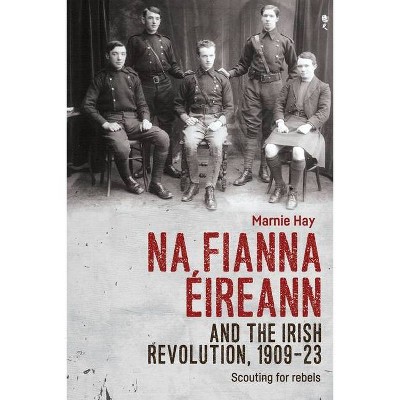
Na Fianna Éireann and the Irish Revolution, 1909-23 - by Marnie Hay (Paperback)
Similar Products
Products of same category from the store
All


Product info
<p/><br></br><p><b> About the Book </b></p></br></br>This book examines the early history of the Irish nationalist youth organisation Na Fianna Éireann and its notable contribution to the Irish Revolution in the period 1909-23.<p/><br></br><p><b> Book Synopsis </b></p></br></br>This book provides a scholarly yet accessible account of the Irish nationalist youth organisation Na Fianna Éireann and its contribution to the Irish Revolution in the period 1909-23. Countess Constance Markievicz and Bulmer Hobson established Na Fianna Éireann, or the Irish National Boy Scouts, as an Irish nationalist antidote to Robert Baden-Powell's scouting movement founded in 1908. Between their establishment in 1909 and near decimation during the Irish Civil War of 1922-23, Na Fianna Éireann recruited, trained and nurtured a cadre of young nationalist activists who made an essential contribution to the struggle for Irish independence. This book will be of interest to historians and students specialising in the history of the Irish Revolution, youth culture, paramilitarism and twentieth-century Ireland. It will also appeal to the general reader with an interest in the history of the Irish Revolution.<p/><br></br><p><b> From the Back Cover </b></p></br></br>'A must-read for both academics and non-academics alike.' <i>Irish Historical Studies</i> This book provides an authoritative and accessible account of the Irish nationalist youth organisation Na Fianna Éireann and its contribution to the Irish Revolution in the period 1909-23. Na Fianna Éireann, or the Irish National Boy Scouts, was established in 1909 in Dublin by Countess Constance Markievicz and Bulmer Hobson as an Irish nationalist antidote to Robert Baden-Powell's Boy Scout movement. The Fianna soon spread beyond the Irish capital, offering a combination of military training, outdoor adventure and Irish cultural activities to a mainly male membership. Between their inception in 1909 and near decimation during the Irish Civil War of 1922-23, Na Fianna Éireann recruited, trained and nurtured a cadre of young nationalist activists who made an essential contribution to the struggle for Irish independence. The book situates the Fianna within the wider international context of uniformed youth groups which emerged in the late-nineteenth and early-twentieth centuries as a response to societal anxieties associated with the coming war in Europe. It compares and contrasts the Fianna to other Irish youth groups of the period and demonstrates how the Fianna served as a conduit for future members of adult paramilitary organisations, most notably the Irish Volunteers, later known as the Irish Republican Army.<p/><br></br><p><b> Review Quotes </b></p></br></br><br>'Ten years after Hay (Dublin City Univ.) revived the memory of a forgotten Irish Republican Brotherhood member in <i>Bulmer Hobson and the Nationalist Movement in Twentieth-Century Ireland </i>(2009), she is back with <i>Na Fianna Éireann and the Irish Revolution, 1909-23.</i> As in her previous work, Hay reveals the importance of the Irish National Boy Scouts, or <i>Na Fianna Éireann</i>, to the Irish Revolution in the years 1909-23. In a conversational tone that eschews academic jargon, this book is both insightful and thoroughly researched. An unusual and welcome feature are four appendixes that identify key pieces of information about <i>Fianna </i>members, such as their birth and death dates, who gave witness statements, and who received pensions. For scholars who are tasked with reviving the memories of marginalized figures from the past, as well as for family members who are seeking to piece together genealogies, the raw data organized in these handy tables is invaluable.' Choice Connect 'A must-read for both academics and non-academics alike.' <i>Irish Historical Studies</i><br><p/><br></br><p><b> About the Author </b></p></br></br>Marnie Hay is a Lecturer in History in the School of History and Geography at Dublin City University
Price History
Price Archive shows prices from various stores, lets you see history and find the cheapest. There is no actual sale on the website. For all support, inquiry and suggestion messages communication@pricearchive.us