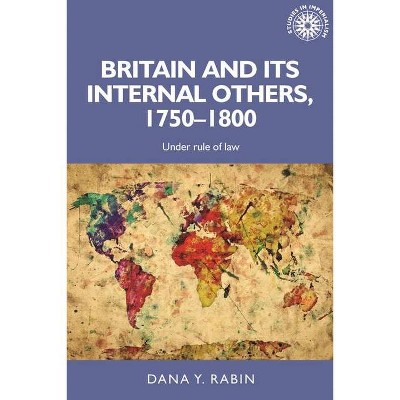
Britain and Its Internal Others, 1750-1800 - (Studies in Imperialism) by Dana Rabin (Hardcover)
Similar Products






Products of same category from the store
All








Product info
<p/><br></br><p><b> About the Book </b></p></br></br>This book<i> </i>revisits six notorious incidents that occasioned vigorous debate in London's courtrooms, streets and presses. Each case adjudicated the presence of outsiders in London - from Jews and Gypsies to Africans and Catholics.<p/><br></br><p><b> Book Synopsis </b></p></br></br><p><em>Britain and its internal others</em> argues that the new emphasis on equality before the law in an age of imperial expansion was no coincidence. Common English men and women were bestowed - discursively at least - with rights and equality at the very moment that the British appropriated rights and property from colonial subjects. As Britain's empire expanded in the second half of the eighteenth century, its law managed interactions among peoples and cultures, linking metropole and colonies in a vast imperial legal web. It was at this time that rule of law became Britain's signature ideology, and a central justification for its imperial authority and superiority. Neither at home nor abroad did the rule of law emerge neatly from abstract principles of English justice, but was instead the product of imperial contact and collision. The English legal process sustained distinctions of race, ethnicity, gender, and class before the law, creating and protecting whiteness as a privileged category. The demands of internal others - Jews, Gypsies, Africans, Catholics, and Irish - for equality before the law drew them into the legal system, challenging longstanding notions of English identity and exposing contradictions in the rule of law.<br /> <br /> Revisiting six notorious legal events involving Britain's internal others in London's courtrooms, streets, and presses - the Jewish Naturalisation Act and the Elizabeth Canning case (1753-54); the Somerset Case (1772); the Gordon Riots (1780); the mutinies of 1797; and Union with Ireland (1800) - this study shows how contact with 'foreign' cultures and communities <em>at home</em>, particularly in London, promoted the ideology of rule of law in the service of empire.</p><p/><br></br><p><b> From the Back Cover </b></p></br></br><i>Britain and its internal others</i> argues that the new emphasis on equality before the law in an age of imperial expansion was no coincidence. Common English men and women were bestowed - discursively at least - with rights and equality at the very moment that the British appropriated rights and property from colonial subjects. As Britain's empire expanded in the second half of the eighteenth century, its law managed interactions among peoples and cultures, linking metropole and colonies in a vast imperial legal web. It was at this time that rule of law became Britain's signature ideology, and a central justification for its imperial authority and superiority. Neither at home nor abroad did the rule of law emerge neatly from abstract principles of English justice, but was instead the product of imperial contact and collision. The English legal process sustained distinctions of race, ethnicity, gender, and class before the law, creating and protecting whiteness as a privileged category. The demands of internal others - Jews, Gypsies, Africans, Catholics, and Irish - for equality before the law drew them into the legal system, challenging longstanding notions of English identity and exposing contradictions in the rule of law. Revisiting six notorious legal events involving Britain's internal others in London's courtrooms, streets, and presses - the Jewish Naturalisation Act and the Elizabeth Canning case (1753-54); the Somerset Case (1772); the Gordon Riots (1780); the mutinies of 1797; and Union with Ireland (1800) - this study shows how contact with 'foreign' cultures and communities <i>at home</i>, particularly in London, promoted the ideology of rule of law in the service of empire.<p/><br></br><p><b> Review Quotes </b></p></br></br><br>'Britain and its internal others creates and stirs a much needed debate on the history of equality before the law by those who were perceived as other due to colonialism. Bringing together six distinct legal events with similar themes is no easy feat, and Rabin does so with ease coupled with detailed scrutiny and explanations.' Rechtsgeschichte - Legal History<br><p/><br></br><p><b> About the Author </b></p></br></br><br>Diana Y. Rabin is Associate Professor of History at the University of Illinois, Urbana-Champaign<br>
Price History
Price Archive shows prices from various stores, lets you see history and find the cheapest. There is no actual sale on the website. For all support, inquiry and suggestion messages communication@pricearchive.us