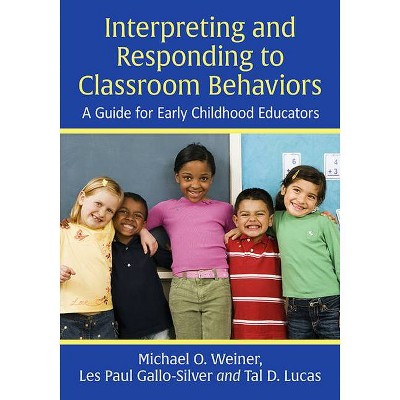
Interpreting and Responding to Classroom Behaviors - by Michael O Weiner & Les Paul Gallo-Silver & Tal D Lucas (Paperback)
Similar Products








Products of same category from the store
All









Product info
<p/><br></br><p><b> About the Book </b></p></br></br>""I spend all my time with this kid!" is a typical teacher complaint when challenged by young children, who disrupt the classroom with rebellious, impulsive, worrisome, and/or odd behaviors. It is vital that teachers gain the skills to holistically decipher and respond to these complex classroom situations. By addressing the underlying meanings that motivate children's behaviors, teachers increase the opportunity for change within the classroom setting Focusing on communication, this book discusses practical ways to apply child developmental theories to help address common classroom situations, problems, and worries. It identifies new frameworks and rationales, such as the troubling child, the testing child, the worrying child, and the hiding child; describes the unique aspects of these children's communication; and offers an easy-to-use language for successful teacher intervention. It also provides an adaptable, week-by-week planning and intervention structure as a way of creating some balance between practicality and theory"--<p/><br></br><p><b> Book Synopsis </b></p></br></br>I spend all my time with this kid! is a typical teacher complaint when challenged by a young child who disrupts the classroom with rebellious, impulsive, worrisome or odd behaviors. It is vital that teachers gain the skills to holistically decipher and respond to these complex classroom situations. By addressing the underlying meanings that motivate children's behaviors, teachers increase the opportunity for change within the classroom setting. Focusing on communication, this book discusses practical ways to apply child developmental theories to help address common classroom situations, problems, and worries. It identifies new frameworks and rationales, such as the troubling child, the testing child, the worrying child, and the hiding child; describes the unique aspects of these children's communication; and offers an easy-to-use language for successful teacher intervention. It also provides an adaptable, week-by-week planning and intervention structure as a way of creating some balance between practicality and theory.<p/><br></br><p><b> Review Quotes </b></p></br></br><br>"The use of the four child communication personas to help inform a teacher's response to classroom behaviors and the Model of Understanding Child Behavior (AURA) are both unique and valuable ways of looking at communication and behavior.... [T]his book will be an asset to educators who ... are looking for a new way to investigate the why behind a student's behavior."--Janice Eisenberg, school counselor<br><p/><br></br><p><b> About the Author </b></p></br></br><b>Michael O. Weiner</b> is a licensed clinical social worker and a Portland, Oregon-based child and adolescent psychotherapist. He has a private practice working with children, adolescents, and parents, teaches social work practice at the graduate school level, and provides child development consultation to early childhood educators. <b></b><b>Les Paul Gallo-Silver</b> is a clinical social worker and an adjunct professor of social work at Adelphi University School of Social Work in Garden City, New York. He has extensive experience providing psychotherapy to children, adolescents and adults specializing in helping them with sexual, medical and environmental traumas. <b></b><b>Tal D. Lucas</b> is a second-grade teacher in Montgomery County, Maryland. She has taught in the primary grades for twenty-three years specializing in reading and literacy. She has spent much of her career as a team leader and has worked as a mentor teacher.
Price History
Price Archive shows prices from various stores, lets you see history and find the cheapest. There is no actual sale on the website. For all support, inquiry and suggestion messages communication@pricearchive.us