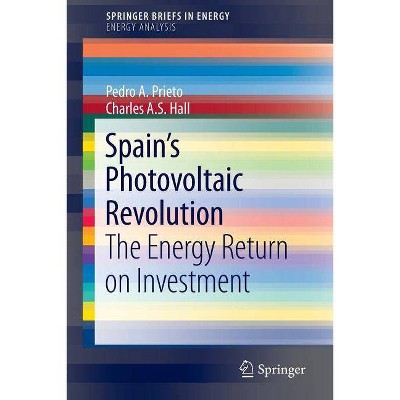
Spain's Photovoltaic Revolution - by Pedro A Prieto & Charles A S Hall (Paperback)
Similar Products








Products of same category from the store
All








Product info
<p/><br></br><p><b> About the Book </b></p></br></br>This book offers the first bulk analysis of a large-scale, real-world <br>deployment of 3.5 GW of installed, grid-connected solar plants in <br>Spain, including all of the factors that limited and adjusted the real <br>electricity output through one full-year cycle.<p/><br></br><p><b> Book Synopsis </b></p></br></br><p>Preface<br>Chapter 1. Solar Energy and Human Civilization<br>Chapter 2. The Evolution of the Demand for Primary Energy and Electricity in Spain<br>Chapter 3. The historical, Legal, Political, Social and Economic Context of Solar Photovoltaics in Spain<br>Chapter 4. Calculating the Energy Return on Energy Invested (EROI) for Spain's Solar Photovoltaic Energy in 2008<br>Chapter 5. Methods: Calculating the Energy Output. The Energy Returned (ER or E<sub>out</sub>)<br>Chapter 6. Methods: Calculating the Energy Input. The energy invested (EI or E<sub>in</sub>)<br>Chapter 7. Results, Sensitivity Analysis and Conclusions<br>References<br>Index</p><p/><br></br><p><b> About the Author </b></p></br></br><p>Pedro A. Prieto is a Telecom Technical Engineer. He has worked in the telecom sector for 30 years as development engineer and professor in the ITT R&D Labs, commercial director, export director and vicepresident of the Radiocommunication division in Alcatel. </p><p>Pedro is vice president of a non-for-profit organization, the Asociaciónpara el Estudio de los RecursosEnergéticos (AEREN), whose media is the web page Crisis Energética (www.crisisenergetica.org), is working as an open space for debate and communications on energy issues and their role in demography, development, economy and ecology and is a reference in the Spanish speaking world for ASPO (The Association for the Study of Peak Oil and Gas, an Association of scientists of all over the world, devoted to the analysis and study of the global peak oil and gas and its consequences for Mankind). AEREN represents ASPO in Spain. He attends many conferences on peak oil and renewable energies.</p><p>Pedro is a board member at ASPO International (www.peakoil.net), and is also member of the non-for-profit organization Científicospor el MedioAmbiente (CiMA) (www.cima.es.org). </p><p>Since 2004, Pedro Prieto has led several solar photovoltaic projects in Spain, a leading world country in solar PV penetration, covering today about 2.2 percent of the total national electric demand, with about 3,750 MW installed base, of which he partially owns and completely manages a 1 MW modern feed-in plant in operation. He has assessed public and private entities in several projects for more than 30 MW, and has supervised, offered and dimensioned many other similar solar photovoltaic projects. </p><p>In 2009 he was engaged as Director of Development for Alternative Energies at a listed Spanish Corporation devoted to the fields of telecommunications, technology, infrastructures and renewable energies. </p><p>At present, Pedro works as a truly independent consultant in solar PV projects. </p> <p>Charles A.S. Hall is Professor of Environmental Science at the State University of New York, College of Environmental Science and Forestry, in Syracuse. He received his PhD. from the University of North Carolina at Chapel Hill under Dr. H.T. Odum. His fields of interest are Systems Ecology, Energy and Biophysical Economics. Dr. Hall is author, coauthor or editor of eight 8 books and 260 scholarly articles that have appeared in <i>Science, Nature, BioScience, American Scientist </i>and other scientific journals. He is best known for his development of the concept of EROI, or energy return on investment, which is an examination of how organisms, including humans, invest energy into obtaining additional energy to improve biotic or social fitness. He has applied these approaches to carbon balance, fish migrations, tropical land use change and the extraction of petroleum and other fuels in both natural and human-dominated ecosystems. Presently, he is developing a new field, biophysical economics, as a supplement or alternative to conventional neoclassical economics, while applying systems and EROI thinking to a broad series of resource and economic issues.</p>
Price History
Cheapest price in the interval: 69.99 on November 8, 2021
Most expensive price in the interval: 69.99 on December 20, 2021
Price Archive shows prices from various stores, lets you see history and find the cheapest. There is no actual sale on the website. For all support, inquiry and suggestion messages communication@pricearchive.us