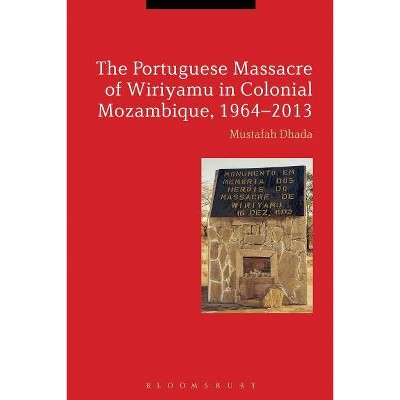
The Portuguese Massacre of Wiriyamu in Colonial Mozambique, 1964-2013 - by Mustafah Dhada (Hardcover)
Similar Products
Products of same category from the store
All

Product info
<p/><br></br><p><b> Book Synopsis </b></p></br></br>In his in-depth and compelling study of perhaps the most famous of Portuguese colonial massacres, Mustafah Dhada<b> </b>explores why the massacre took place, what Wiriyamu was like prior to the massacre, how events unfolded, how we came to know about it and what the impact of the massacre was, particularly for the Portuguese empire.<br/><br/>Spanning the period from 1964 to 2013 and complete with a foreword from Peter Pringle, this chronologically arranged book covers the liberation war in Mozambique and uses fieldwork, interviews and archival sources to place the massacre firmly in its historical context. <i>The Portuguese Massacre of Wiriyamu in Colonial Mozambique, 1964-2013</i> is an important text for anyone interested in the 20th-century history of Africa, European colonialism and the modern history of war.<p/><br></br><p><b> Review Quotes </b></p></br></br><br><p>"The result of a decade of scrupulous and original research, [this book] is a precious contribution to the history of Portuguese late colonialism ... Dhada's work both expands and perfects historical knowledge and method. It serves as a powerful corrective to old and contemporary mystifications about the colonial modi operandi ... Its content clearly exposes the previous flawed accounts, revealing their superficial, speculative, and second-rate research." -<i> American Historical Review</i> <p/>"While he has assiduously made his way through a mass of archival and other written sources, the pre-eminent original contribution of this book is the material gathered from interviews with survivors of the killings and others who had been in and around Wiriyamu at the time. These include a perpetrator who, penitent in the decades after the event, provides testimony that strengthens the case for official culpability." - <i>English Historical Review</i> <p/>"Mustafah Dhada's important and idiosyncratic book ... [is an] essential document that provides extensive lists of sources, records of census results and of the recovered names of the victims, and a roster of the individuals who provided personal testimony about one of the worst atrocities of the liberation war in Mozambique. - <i>The International Journal of African Historical Studies</i> <p/>"This book is a feat of investigative research and layered storytelling. Dhada unearths with exceptional degree of detail the events surrounding the infamous Portuguese colonial massacre of Wiriyamu, as well as the ways in which competing narratives about this event were crafted, buried, revealed, diffused, and contested. The book leads the reader through a maze of documents and memories, until a shattering vision of the destruction of Wiriyamu in which even the trees come to life to testify. The writing is alive with personal passion spanning decades; rich, sophisticated, and utterly compelling." --<i>Paolo Israel, University of the Western Cape, South Africa, author of In Step with the Times: Mapiko Masquerades of Mozambique</i> <p/>"The murdered inhabitants of Wiriyamu, casualties of brutal Portuguese refusal to relinquish imperial rule, now have the recognition they deserve. Mustafah Dhada's heroic work of historical reconstruction relocates these lost lives: documenting the names of the 385, he reminds us of the potential they represented. Dhada interweaves the narrative of the massacre with the fierce course of decolonization and subsequent debates on the legacy of Wiriyamu. Portugal's young officers, persuaded by Mozambicans, overthrew their generals and made Portugal a democracy; Mozambique gained independence but could not get free of Cold War or imperial struggles. In its interplay of revolutionaries, priests, villagers, soldiers, and journalists, this multilayered work shows how senseless exercise of power, accompanied by denial, remains with us." --<i>Patrick Manning, University of Pittsburg, USA and President, American Historical Association <p/></i>"The book is written in engaging and accessible prose ... [A] valuable addition to the history of war and counterinsurgency in Mozambique ... Dhada has written an indispensable account of the Mozambican war for independence." - <i>Journal of Military History<br></i></p><br><p/><br></br><p><b> About the Author </b></p></br></br><p><b>Mustafah Dhada</b> is Professor of History at California State University, Bakersfield, USA, and Research Associate at the Center for Social Studies, Coimbra University, Portugal. He is the author of <i>Warriors at Work</i> (1993). <p/><b>Peter Pringle</b> is a foreign correspondent, investigative reporter and writer. He is the co-author of <i>Those Are Real Bullets: Bloody Sunday, Derry, 1972</i> (2000).</p>
Price History
Price Archive shows prices from various stores, lets you see history and find the cheapest. There is no actual sale on the website. For all support, inquiry and suggestion messages communication@pricearchive.us