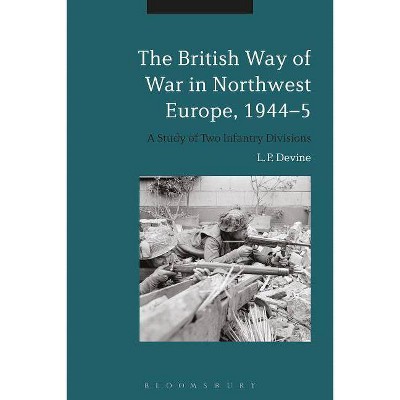
The British Way of War in Northwest Europe, 1944-5 - by L P Devine (Paperback)
Similar Products

Products of same category from the store
All




Product info
<p/><br></br><p><b> Book Synopsis </b></p></br></br>This book<i> </i>examines the experience of two British Infantry Divisions, the 43rd (Wessex) and 53rd (Welsh), during the Overlord campaign in Northwest Europe. To understand the way the British fought during Operation Overlord, the book considers the political and military factors between 1918 and 1943 before addressing the major battles and many of the minor engagements and day-to-day experiences of the campaign.<br/><br/>Through detailed exploration of unit war diaries and first-hand accounts, Louis Devine demonstrates how Montgomery's way of war translated to the divisions and their sub units. While previous literature has suggested that the British Army fought a cautious war in order to avoid the heavy casualties of the First World War, Devine challenges this concept by showing that the Overlord Campaign fought at sub-divisional levels was characterised by command pressure to achieve results quickly, hasty planning and a reliance on massive artillery and mortar contributions to compensate for deficiencies in anti-tank and armoured support. <br/><br/>By following two British infantry divisions over a continuous period and focusing on soldiers' experience to offer a perspective 'from below', as well as challenging the consensus of a 'cautious' British campaign, this book provides a much-needed re-examination of the Overlord campaign which will be of great interest to students and scholars of the Second World War and modern military history in general.<p/><br></br><p><b> Review Quotes </b></p></br></br><br>Devine makes an important contribution to the ongoing debate regarding the British way of war and combat effectiveness in Northwest Europe during 1944-1945. Via a micro examination of two infantry divisions, he reveals that combat at the sharp end sometimes differed markedly from the official cautious approach of 'colossal cracks' and casualty conservation. Where circumstances precluded detailed planning, particularly in myriad minor tactical operations, a fast paced operational tempo that was inconsistent with the approach of casualty conservation characterized infantry combat, often resulting in heavy casualties. A must read for those interested in how the WWII British Army fought and performed.<br/>Russell A. Hart, Hawai'i Pacific University, USA<br><p/><br></br><p><b> About the Author </b></p></br></br><b>Louis Paul Devine</b> received a PhD in History from Plymouth University, UK after a long career in the Royal Navy. He currently lectures on a range of subjects including the Second World War, the Cold War and 20th-century British History.
Price History
Price Archive shows prices from various stores, lets you see history and find the cheapest. There is no actual sale on the website. For all support, inquiry and suggestion messages communication@pricearchive.us