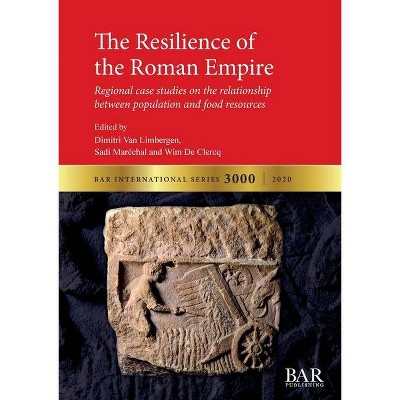
The Resilience of the Roman Empire - (BAR International) by Dimitri Van Limbergen & Sadi Maréchal & Wim de Clercq (Paperback)
Similar Products

Products of same category from the store
All




Product info
<p/><br></br><p><b> Book Synopsis </b></p></br></br>The Resilience of the Roman Empire discusses the relationship between population and regional development in the Roman world from the perspective of archaeology. By adapting a comparative approach, the focus of the volume lies on exploring the various ways in which regional communities actively responded to population growth or decline in order to keep going on the land available to them. The starting point of the theoretical framework for the case studies is the agricultural intensification models developed by Thomas Malthus and Ester Boserup. In order to advance the debate on the validity of these models for identifying the societal and economic pathways of the Roman world, the contributors incorporate the concepts of resilience and diversity into their approach, and shift attention from the longue-durée to how people managed to sustain themselves over shorter periods of time. The aim of the volume is not to discard the theories of Malthus and Boserup, but rather to deconstruct overly strict Malthusian or Boserupian scenarios, and as such introduce novel and more layered ways of thinking by exploring resilience and variability in human responses to population growth/decline in the Roman world.<p/><br></br><p><b> Review Quotes </b></p></br></br><br><p>'The volume's greatest strength is without doubt its fresh and thorough methodological approach to aspects of regionalism and localism in Roman agricultural production, ranging from the landscapes of the Mediterranean to Northwestern Europe. ... The discussion of major case studies is extremely meticulous and grounded in an expert understanding of both the literary and the archaeological evidence.' Dr Dominik Maschek, University of Oxford</p><p><br></p><p>'This is an original and very welcome contribution to the study of agricultural practices in the Roman World in relation to economic developments. It complements well current synthetic ancient historical scholarship on agricultural innovation and its role in economic and demographic expansion with solid archaeological case studies.' Dr Tymon de Haas, Universiteit Leiden</p><br>
Price History
Price Archive shows prices from various stores, lets you see history and find the cheapest. There is no actual sale on the website. For all support, inquiry and suggestion messages communication@pricearchive.us