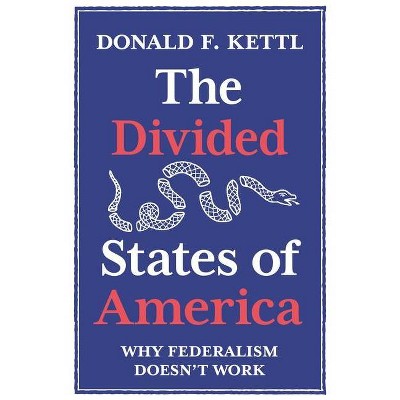
The Divided States of America - by Donald F Kettl (Hardcover)
Similar Products




Products of same category from the store
All





Product info
<p/><br></br><p><b> About the Book </b></p></br></br>"As James Madison led America's effort to write its Constitution, he made two great inventions-the separation of powers and federalism. The first is more famous, but the second was most essential because, without federalism, there could have been no United States of America. Federalism has always been about setting the balance of power between the federal government and the states-and that's revolved around deciding just how much inequality the country was prepared to accept in exchange for making piece among often-warring states. Through the course of its history, the country has moved through a series of phases, some of which put more power into the hands of the federal government, and some rested more power in the states. Sometimes this rebalancing led to armed conflict. The Civil War, of course, almost split the nation permanently apart. And sometimes it led to political battles. By the end of the 1960s, however, the country seemed to have settled into a quiet agreement that inequality was a prime national concern, that the federal government had the responsibility for addressing it through its own policies, and that the states would serve as administrative agents of that policy. But as that agreement seemed set, federalism drifted from national debate, just as the states began using their administrative role to push in very different directions. The result has been a rising tide of inequality, with the great invention that helped create the nation increasingly driving it apart"--<p/><br></br><p><b> Book Synopsis </b></p></br></br><p><b>Why federalism is pulling America apart--and how the system can be reformed</b> <p/>Federalism was James Madison's great invention. An innovative system of power sharing that balanced national and state interests, federalism was the pragmatic compromise that brought the colonies together to form the United States. Yet, even beyond the question of slavery, inequality was built into the system because federalism by its very nature meant that many aspects of an American's life depended on where they lived. Over time, these inequalities have created vast divisions between the states and made federalism fundamentally unstable. In<i> The Divided States of America</i>, Donald Kettl chronicles the history of a political system that once united the nation--and now threatens to break it apart. <p/>Exploring the full sweep of federalism from the founding to today, Kettl focuses on pivotal moments when power has shifted between state and national governments--from the violent rebalancing of the Civil War, when the nation almost split in two, to the era of civil rights a century later, when there was apparent agreement that inequality was a threat to liberty and the federal government should set policies for states to enact. Despite this consensus, inequality between states has only deepened since that moment. From health care and infrastructure to education and the environment, the quality of public services is ever more uneven. Having revealed the shortcomings of Madison's marvel, Kettl points to possible solutions in the writings of another founder: Alexander Hamilton. <p/>Making an urgent case for reforming federalism, <i>The Divided States of America</i> shows why we must--and how we can--address the crisis of American inequality.</p><p/><br></br><p><b> Review Quotes </b></p></br></br><br>The situation, Mr. Kettl concludes, 'is serious, perhaps even bleak.' He chooses to believe that it 'need not be fatal to the nation's grand democratic vision.' In these perilous times, made worse by a pandemic, one can only hope he is right.<b>---Glenn C. Altschuler, <i>Pittsburgh Post-Gazette</i></b><br><br><p>A clear and cogent exposition.</p><b>---Colin Woodard, <i>Washington Post</i></b><br><br><p>The book sets the stage for a more informed inquiry into the quintessential public administration problem - can we use historical knowledge to design better institutions and incentives to address socioeconomic inequalities of the future.</p><b>---Meril Antony, <i>Journal of Public Affairs Education</i></b><br><p/><br></br><p><b> About the Author </b></p></br></br><b>Donald F. Kettl</b> is professor emeritus and former dean of the School of Public Policy at the University of Maryland. Until his retirement, he was the Sid Richardson Professor at the LBJ School at the University of Texas at Austin. His books include <i>Can Governments Earn Our Trust? </i>and <i>Escaping Jurassic Government</i>. Twitter @donkettl
Price History
Cheapest price in the interval: 18.99 on October 23, 2021
Most expensive price in the interval: 18.99 on November 8, 2021
Price Archive shows prices from various stores, lets you see history and find the cheapest. There is no actual sale on the website. For all support, inquiry and suggestion messages communication@pricearchive.us