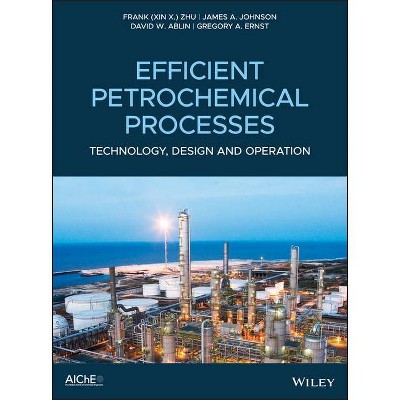
Efficient Petrochemical Processes - by Zhu & James a Johnson & David W Ablin & Gregory A Ernst (Hardcover)
Similar Products







Products of same category from the store
All








Product info
<p/><br></br><p><b> About the Book </b></p></br></br>"This book covers the application of methods and tools for energy optimization and process design. It focuses the application of these methods on petrochemical process units such as the aromatics process unit. The book provides practical methods and tools to industrial practitioners with the focus on improving industrial energy efficiency, reducing capital investment, and optimizing yields via better design, operation, and optimization. Broken down into six parts the book covers a range of topics including: Aromatics Process Description; Process Design Considerations; Petrochemical Separation Design; Process Integration; Process system optimization; Types of revamps; Equipment assessment; Common operating issues; and Troubleshooting case analysis to name a few. Aromatics processes are very important for our daily lives as they make our basic petrochemical building blocks: benzene, toluene, and xylenes (BTX). Benzene is used in the production of more than 250 different products; the most important benzene derivatives are ethylbenzene, cumene, and cyclohexanes. The xylene product, known as mixed xylene, contains four different C8 aromatic isomers: para-xylene, ortho-xylene, meta-xylene, and ethylbenzene. Para-xylene is the most important aromatic isomer; it is used almost exclusively in the production of polyester fibers, resins, and films. Toluene is mainly used to produce benzene through hydrodealkylation. It is becoming increasingly important in the production of xylene through toluene disproportionation and transalkylation with C9 aromatics"--<p/><br></br><p><b> Book Synopsis </b></p></br></br><p><b>A GUIDE TO THE DESIGN, OPERATION, CONTROL, TROUBLESHOOTING, OPTIMIZATION AS WELL AS THE RECENT ADVANCES IN THE FIELD OF PETROCHEMICAL PROCESSES</b></p> <p><i>Efficient Petrochemical Processes: Technology, Design and Operation</i> is a guide to the tools and methods for energy optimization and process design. Written by a panel of experts on the topic, the book highlights the application of these methods on petrochemical technology such as the aromatics process unit. The authors describe practical approaches and tools that focus on improving industrial energy efficiency, reducing capital investment, and optimizing yields through better design, operation, and optimization.</p> <p>The text is divided into sections that cover the range of essential topics: petrochemical technology description; process design considerations; reaction and separation design; process integration; process system optimization; types of revamps; equipment assessment; common operating issues; and troubleshooting case analysis. This important book: </p> <ul> <li>Provides the basic knowledge related to fundamentals, design, and operation for petrochemical processes</li> <li>Applies process integration techniques and optimization techniques that improve process design and operations in the petrochemical process</li> <li>Provides practical methods and tools for industrial practitioners</li> <li>Puts the focus on improving industrial energy efficiency, reducing capital investment, and optimizing yields</li> <li>Contains information on the most recent advances in the field.</li> </ul> <p>Written for managers, engineers, and operators working in process industries as well as university students, <i>Efficient Petrochemical Processes: Technology, Design and Operation</i> explains the most recent advances in the field of petrochemical processes and discusses in detail catalytic and adsorbent materials, reaction and separation mechanisms.</p><p/><br></br><p><b> From the Back Cover </b></p></br></br><p><b>A GUIDE TO THE DESIGN, OPERATION, CONTROL, TROUBLESHOOTING, OPTIMIZATION AS WELL AS THE RECENT ADVANCES IN THE FIELD OF PETROCHEMICAL PROCESSES</b> <p><i>Efficient Petrochemical Processes: Technology, Design and Operation</i> is a guide to the tools and methods for energy optimization and process design. Written by a panel of experts on the topic, the book highlights the application of these methods on petrochemical technology such as the aromatics process unit. The authors describe practical approaches and tools that focus on improving industrial energy efficiency, reducing capital investment, and optimizing yields through better design, operation, and optimization. <p>The text is divided into sections that cover the range of essential topics: petrochemical technology description; process design considerations; reaction and separation design; process integration; process system optimization; types of revamps; equipment assessment; common operating issues; and troubleshooting case analysis. This important book: <ul> <li>Provides the basic knowledge related to fundamentals, design, and operation for petrochemical processes</li> <li>Applies process integration techniques and optimization techniques that improve process design and operations in the petrochemical process</li> <li>Provides practical methods and tools for industrial practitioners</li> <li>Puts the focus on improving industrial energy efficiency, reducing capital investment, and optimizing yields</li> <li>Contains information on the most recent advances in the field.</li> </ul> <p>Written for managers, engineers, and operators working in process industries as well as university students, <i>Efficient Petrochemical Processes: Technology, Design and Operation</i> explains the most recent advances in the field of petrochemical processes and discusses in detail catalytic and adsorbent materials, reaction and separation mechanisms.<p/><br></br><p><b> About the Author </b></p></br></br><p><b>FRANK (XIN X.) ZHU, PHD</b>, is Senior Fellow at Honeywell UOP, Des Plaines, Illionis. He is a leading expert in industrial process design, modeling, and energy efficiency. He holds 60 US patents; is the co-founder for ECI International Conference: CO2 Summit and the recipient of AIChE Energy Sustainability Award. <p><b>JAMES A. JOHNSON</b> is the Director of Petrochemical Development in the R&D Department of Honeywell UOP. He has authored several publications and holds 36 US patents. <p><b>DAVID W. ABLIN</b> was a Fellow at the Aromatics Technology Center of Honeywell UOP before retiring in 2016. He holds 14 U.S. patents and earned several UOP Engineering awards. <p><b>GREGORY A. ERNST</b> is a Technology Specialist at Honeywell UOP, focusing on aromatics technologies with experience in commissioning, field services, and on-site troubleshooting of operating plants.
Price History
Price Archive shows prices from various stores, lets you see history and find the cheapest. There is no actual sale on the website. For all support, inquiry and suggestion messages communication@pricearchive.us