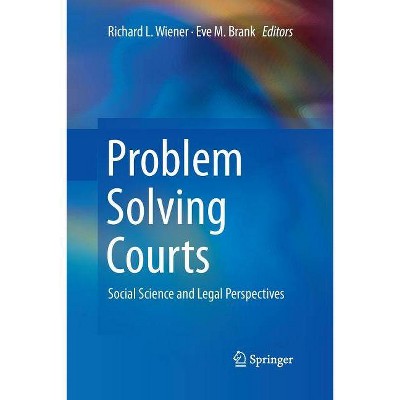
Problem Solving Courts - by Richard L Wiener & Eve M Brank (Paperback)
Similar Products
Products of same category from the store
All






Product info
<p/><br></br><p><b> Book Synopsis </b></p></br></br>In order to make the criminal court system more effective there has been a growing trend to have courts participate in what is essentially a rehabilitation strategy. Such courts are often referred to as "problem-solving" because they are working on root causes of criminal behavior as part of the dispensation of justice. This major shift in the role of the courts means that the court works closely with prosecutors, public defenders, probation officers, social workers, and other justice system partners to develop a strategy that pressures offenders to complete a treatment program which will ultimately, hopefully prevent recidivism. Research has shown that this kind of strategy has a two-fold benefit. It has been successful in helping offenders turn their lives around which leads to improved public safety and the ultimate saving of public funds. This book is the first to focus exclusively on problem solving courts, and as such it presents an overview of the rationale and scientific evidence for such courts as well as individual sections on the key areas in which these courts are active. Thus there is specific attention paid to domestic violence, juvenile criminality, mental health, and more. Throughout, research findings are incorporated into general discussions of these courts operate and ideally what they are trying to accomplish. There is also discussion of how such courts should evolve in the future and the directions that further research should take.<p/><br></br><p><b> From the Back Cover </b></p></br></br><p>Substance abuse. Child welfare. Domestic violence. Mental illness. Cases revolving around these concerns keep the court system under constant stress, often resulting in less than satisfactory outcomes. In contrast, problem solving courts offer an innovative alternate path where traditional courts leave off, an encouraging environment with the potential to benefit offenders, victims, and society alike. </p><p><i>Problem Solving Courts</i> explores the concepts and practices of therapeutic jurisprudence for professionals in the legal and psychology fields. Differences from traditional criminal courts are analyzed through a number of perspectives, particularly as problem solving courts require offenders to receive rehabilitative services instead of harsher punishment. By focusing on solutions and being collaborative rather than adversarial, these courts are seen as curbing recidivism and the "revolving door" scenarios frequently associated with legal process. Coverage includes case vignettes from successful programs across the U.S. as well as Australia and New Zealand, and contributors examine training and other issues relevant to the problem solving model. Among the topics featured: </p><ul><li>The union of science and law in child welfare cases.</li><li>Mental health courts: competence, responsibility, and proportionality.</li><li>Gender issues in problem solving courts.</li><li>Unified family courts: an interdisciplinary framework.</li><li>Intended and unintended consequences of problem solving courts.</li><li>Therapeutic jurisprudence in practice. </li></ul><p>Blending basic and in-depth information across disciplines, <i>Problem Solving Courts</i> offers psychologists, family law specialists, family therapists, clinical psychologists, social workers, and legal and psychology practitioners a deeper understanding of this transformative aspect of the justice system.</p><p/><br></br><p><b> Review Quotes </b></p></br></br><br>"The good news for readers of <i>Problem Solving Courts </i>is that the various chapters are well written without the abrupt changes in style sometimes experienced in edited volumes. Whether for an upper level undergraduate or a graduate student with an interest in psychology and the law or for professionals in the field, a clear picture of the rationales for problem solving courts and of generic implications for practice--psychological, social, legal--is provided."<br>Richard W. Bloom<br><i>PsycCRITIQUES</i><br>December 18, 2013, Vol. 58, No. 49, Article 4<br>
Price History
Price Archive shows prices from various stores, lets you see history and find the cheapest. There is no actual sale on the website. For all support, inquiry and suggestion messages communication@pricearchive.us