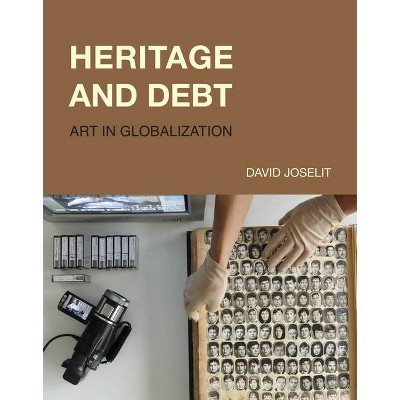
Heritage and Debt - (October Books) by David Joselit (Hardcover)
Similar Products



![No, David! - (David Books [Shannon]) by David Shannon (Hardcover)](https://target.scene7.com/is/image/Target/GUEST_e8e077f5-9e21-4075-85a5-95a540f6e77f)




![David Gets in Trouble - (David Books [Shannon]) by David Shannon (Hardcover)](https://target.scene7.com/is/image/Target/GUEST_aa170769-9d3c-441a-b8ec-92aa9c1881db)
Products of same category from the store
All




Product info
<p/><br></br><p><b> About the Book </b></p></br></br>"Heritage and Debt is a comparative study of global contemporary art that addresses artworks from around the world without falling into a survey of successive regions as most art-historical accounts of globalization do. It demonstrates that art's globalization has the capacity to redress Western modernism's historical responsibility for the cultural dispossession of the Global South. Both imperialism and slavery--two primary means of capital accumulation in the 19th century-asserted the cultural inferiority of non-Western cultures as justification for appropriating their land, labor, and the personal freedom of their peoples. While non-Western art was denigrated and suppressed in its places of origin, it was nevertheless appropriated by European modernism in the subordinate position of "primitivism" or "exoticism," or collected as defunct anthropological relics in encyclopedic or natural history museums in the European or American metropolis. Global contemporary art confronts this history of dispossession in its reanimation of cultural heritage as a contemporary resource. Since the 1980s artists from around the world have reclaimed local traditions to challenge the predominance of Euro-American contemporary art. Likewise, under global conditions, the development of heritage, which I define as any inherited cultural tradition in any region of the world, whether ancient or modern, has become an effective, even a necessary resource for localities in competing for investment, tourist dollars, and also indirectly, diplomatic or soft power. Heritage is thus both a symbolic and an economic asset, as indicated by the worldwide proliferation of new museums, often devoted to modern and contemporary art. Inspired by postcolonial thinkers and new directions in anthropology, Heritage and Debt argues that in global contemporary art, tradition-or heritage-has become a dynamic source of modern and contemporary aesthetic expressions in the Global South. Heritage and Debt will serve as a valuable resource in defining the burgeoning field of global contemporary art. The fact that the book's arguments are deeply grounded in the work of critics and historians from Africa, India, Latin America, Australia, and Asia should make Heritage and Debt relevant in many locations, as will its fundamentally comparative structure"--<p/><br></br><p><b> Book Synopsis </b></p></br></br><b>How global contemporary art reanimates the past as a resource for the present, combating modern art's legacy of Eurocentrism.</b><p>If European modernism was premised on the new--on surpassing the past, often by assigning it to the "traditional" societies of the Global South--global contemporary art reanimates the past as a resource for the present. In this account of what globalization means for contemporary art, David Joselit argues that the creative use of tradition by artists from around the world serves as a means of combatting modern art's legacy of Eurocentrism. Modernism claimed to live in the future and relegated the rest of the world to the past. Global contemporary art shatters this myth by reactivating various forms of heritage--from literati ink painting in China to Aboriginal painting in Australia--in order to propose new and different futures. Joselit analyzes not only how heritage becomes contemporary through the practice of individual artists but also how a cultural infrastructure of museums, biennials, and art fairs worldwide has emerged as a means of generating economic value, attracting capital and tourist dollars.</p><p>Joselit traces three distinct forms of modernism that developed outside the West, in opposition to Euro-American modernism: postcolonial, socialist realism, and the underground. He argues that these modern genealogies are synchronized with one another and with Western modernism to produce global contemporary art. Joselit discusses curation and what he terms "the curatorial episteme," which, through its acts of framing or curating, can become a means of recalibrating hierarchies of knowledge--and can contribute to the dual projects of decolonization and deimperialization.</p><p/><br></br><p><b> Review Quotes </b></p></br></br><br>The issues in <i>Heritage and Debt</i> need to be faced, for they won't go away. For that reason, this book matters. <i><b>- Hyperallergic <p/></b></i>What David Joselit offers in <i>Heritage and Debt </i>(2020) is a convincing description of the global and historical dynamics that produced 'contemporary art' as something distinct from what preceded it. For most observers of art and its history today, that question would be answered with some combination of 'postmodernism' and 'modernism, ' which is not incorrect. But on Joselit's account, that answer is both woefully incomplete and politically compromised.<b> <i><b>- ArtReview</b></i></b><br>
Price History
Price Archive shows prices from various stores, lets you see history and find the cheapest. There is no actual sale on the website. For all support, inquiry and suggestion messages communication@pricearchive.us