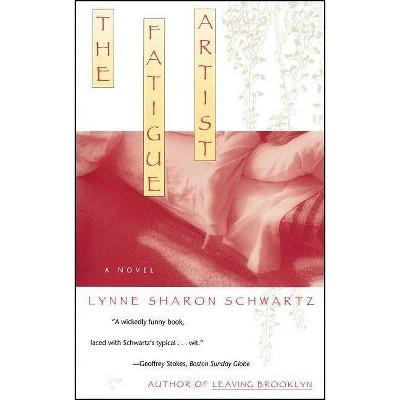
The Fatigue Artist - by Lynne Sharon Schwartz (Paperback)
Compare Prices Across Stores10000
All





More Fiction at Target11+
All



Product Details
<p/><br></br><p><b> About the Book </b></p></br></br>A major voice in American ficion speaks in The Fatigue Artist, a witty portrait of a woman who embarks on a picaresque journey through past and present in an attempt to overcome an inexplicable illness. "Wonderfully intelligent and . . . sexy".--Alice Adams.<p/><br></br><p><b> Book Synopsis </b></p></br></br><i>The Fatigue Artist</i> is a refreshingly candid story about life, love, and survival in the contemporary world. A writer living in New York City, Laura is overwhelmed by a mysterious lethargy and retreats to her bed where she reflects on the loves and losses of her recent past and seeks the cure to her perplexing tiredness. <br> Fortified by the Eastern teachings of her Tai Chi instructor and the nurturing attentions of friends and a acupuncturist, Laura crawls out of her somnambulism with intelligent determination in search of peace and resurrection. <i>The Fatigue Artist</i> is both a moving chronicle of a woman's search for meaning and a wry depiction of modern urban life.<p/><br></br><p><b> About the Author </b></p></br></br>Lynne Sharon Schwartz <p/> Lynne Sharon Schwartz grew up in Brooklyn, New York, <br> in the 1950s, in a middle-class family. Her father was a tax<br> lawyer, her mother a homemaker. Strongly influenced by<br> her immigrant grandparents, Schwartz had a large, extended <br> family with strong traditions and European values. <p/> As a child, she remembers noticing the details of<br> things -- conversations, emotion, faces. By age seven, she<br> was a writer, her themes were often philosophical and<br> moral. I wrote one about how the world came into<br> being, she says. And it was a kind of a deist vision of<br> God who was...a kind scientist....I wasn't a genius or anything, <br> I mean, I wrote like a seven-year old. But I thought<br> about things. And my parents were wonderful. They<br> encouraged me. <p/> With a Bachelor's degree from Barnard and a Master's<br> degree from Bryn Mawr, Schwartz completed her course<br> work for a Doctorate in comparative literature, when her<br> life changed direction. She says, I was just about to write<br> my thesis, in 1972, and I couldn't face it; every topic I<br> thought of was no good, and every time I went down in<br> the NYU stacks I'd just get sick. Then suddenly it dawned<br> on me: I was a little over thirty, and if I was going to<br> write, I'd better write. I had thought it would happen -- I<br> would wake up one day and be a writer -- but I didn't do<br> it. That has a lot to do with the way women are brought<br> up: you expect that things will happen to you, not that<br> you should go and pursue them. So I dropped the Ph.D., <br> went home, and wrote. <p/> For many years she wrote short stories, and in 1972<br> was approached by an editor who suggested she string a<br> series of shorts stories together into a longer novel. The<br> result was her brilliantly acclaimed first novel, <i>Rough<br> Strife</i>, an intimate psychological portrait of a marriage in<br> trouble. <p/> Perhaps because of her family background, as well as<br> her years of studying European literature, Schwartz feels<br> an affinity to 19th-century writers. Marcel Proust and<br> Henry James are her literary idols and she was also influenced <br> by the poets, Chaucer, Shakespeare, and Keats. <p/> The way they use language has remained in my ear, she<br> says, and in my writing I try to keep a sense of the stages<br> the language has passed through, and the way poets use<br> it. She acknowledges that she is going against the current<br> literary trend with its spare style but isn't particularly<br> concerned about the criticism. She says, I can't write<br> that way because I simply don't see life that way. For me, <br> every gesture, every sentence, every interaction is taught<br> with meaning, with layers of complexity, and I can't write<br> as if that weren't true. <p/> <i>The Fatigue Artist</i> is Schwartz's fifth novel, and her<br> most autobiographical. In 1991, after a period of great<br> stress, she found herself sick with Chronic Fatigue<br> Syndrome. For three or four months, she lay in bed with<br> only the strength to talk on the phone. In many ways, the<br> calls were life sustaining, and as she gradually felt better.<br> She began to write down the anecdotes and stories her<br> friends told her, as well as her own observations of what<br> was going on around her in the contemporary world.<br> Determined to use what life had to offer, she turned the<br> illness into a witty and humorous novel of introspection<br> and healing. When I noticed all these...things happening<br> around me, I kept thinking, I'll use it, I'll use it, she says.<br> It's not going to be a waste of time. I have a friend, a<br> very old, close friend, and whenever we're going through<br> anything difficult, we say to each other, 'Why worry?<br> Why? Some day all of this will become literature.' <p/> Lynne Sharon Schwartz currently lives in New York<br> City with her husband and has taught writing and literature <br> at Columbia, Boston, and Rice universities and at the<br> Writers' Workshop at the University of Iowa. She has<br> received numerous awards, and has been given grants for<br> her fiction by the John Simon Guggenheim Foundation<br> and the National Endowment for the Arts. Her newest<br> book, <i>Ruined by Reading</i>, will be published in May. <p/>OTHER WORKS BY LYNNE SHARON SCHWARTZ: <br><ul><br><li><br><i>Rough Strife</i> <p/><li><br><i>Balancing Acts</i> <p/><li><br><i>Disturbances in the Field</i> <p/><li><br><i>Leaving Brooklyn</i> <p/><li><br><i>A Lynne Sharon Schwartz Reader: <p/>Selected Prose and Poetry</i> <p/><li><br><i>The Melting Pot and Other Subversive Stories</i> <p/><li><br><i>Aquatinted with the Night</i><br></ul> <p/> <p/><b><br>Reading Group Discussion Points <p/>Other Books With Reading Group Guides<br></b>