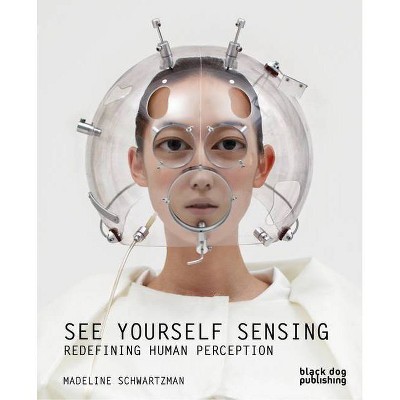
See Yourself Sensing - by Madeline Schwartzman (Paperback)
Similar Products






Products of same category from the store
All





Product info
<p/><br></br><p><b> About the Book </b></p></br></br>" ... Is the first book to survey the intersection between design, the body, science and the senses, from the utopian pods and head gear of the 1960s, to the high-tech prostheses, wearable computing, implants, and interfaces between computers and humans of the past decade ..."--Introduction, p. 6.<p/><br></br><p><b> Book Synopsis </b></p></br></br>Did you know that we can see with our tongue? Or that we can plug our nervous system directly into a computer? With cybernetics, prosthetics, robotics, nanotechnology and neuroscience altering the way we perceive and experience space, the body has re-emerged as an important architectural site, revealing its astonishing potential as a creative medium. <p/><i>See Yourself Sensing: Redefining Human Perception</i> is an explosive and unique survey that captures the fascinating relationship between design, the body, the senses, and technology. A timely discussion with cutting-edge design, <i>See Yourself Sensing</i> examines work from the last 50 years by artists, architects and designers who have been experimenting with the boundaries of our senses, changing the way we experience the world. <p/>The book explores the work of both established and upcoming artists, including internet sensation Daito Manabe, Korean artist Hyungkoo Lee, Lawrence Malstaf and collectives such as realities: united and Viennese-based Gelitin, and figures of worldwide acclaim, such as Ann Hamilton, Ernesto Neto, Carsten Höller, Olafur Eliasson and Rebecca Horn.<br><p/><br></br><p><b> Review Quotes </b></p></br></br><br>Exploring the relationship between the body, design and technology, the book is perplexing and thought-provoking. <i>Aesthetica Magazine</i> <p/>[A] stimulating survey of body-related art and design. <i>The Architectural Review</i> <p/>There are plenty of works to illustrate each chapter, many of which i had never heard about and was therefore enthusiastic to encounter. But it is also a well-paced, well-researched essay about the impact technologies are having on the architecture of our senses. <i>We Make Money Not Art Blog</i> <p/>The lavishly photographed, beautifully designed tome presents work 'at the forefront of investigation' - in architecture, fine art, design, cybernetics, and neuroscience...The objects in <i>See Yourself Sensing</i> are quite literally mind-blowing. <i>Bernard Magazine</i> <p/>...a tour de force, bursting with insights. David Howes: Director of the Concordia University Sensoria Research Team<br><br><p/><br></br><p><b> About the Author </b></p></br></br>Madeline Schwartzman is a New York City filmmaker and architect. A graduate of the Yale School of Architecture, her multi-disciplinary practice combines architecture, film/video and writing and her body of work includes a feature-length film titled Aphrodisiac, over fifteen shorts that have screened at festivals in the United States and abroad, and a recently completed novel. Schwartzman holds long-term teaching positions at Barnard College, Columbia University (Professor (adjunct), architectural design) and at Parsons The New School for Design (Part-time Associate Professor, interdisciplinary design and drawing).<br>
Price History
Price Archive shows prices from various stores, lets you see history and find the cheapest. There is no actual sale on the website. For all support, inquiry and suggestion messages communication@pricearchive.us