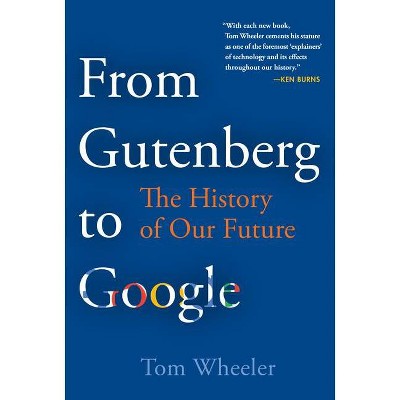
From Gutenberg to Google - by Tom Wheeler (Hardcover)
Similar Products








Products of same category from the store
All







Product info
<p/><br></br><p><b> Book Synopsis </b></p></br></br><p><b>Network revolutions of the past have shaped the present and set the stage for the revolution we are experiencing today</b></p><p>In an era of seemingly instant change, it's easy to think that today's revolutions--in communications, business, and many areas of daily life--are unprecedented. Today's changes may be new and may be happening faster than ever before. But our ancestors at times were just as bewildered by rapid upheavals in what we now call "networks"--the physical links that bind any society together.</p><p>In this fascinating book, former FCC chairman Tom Wheeler brings to life the two great network revolutions of the past and uses them to help put in perspective the confusion, uncertainty, and even excitement most people face today. The first big network revolution was the invention of movable-type printing in the fifteenth century. This book, its millions of predecessors, and even such broad trends as the Reformation, the Renaissance, and the multiple scientific revolutions of the past 500 years would not have been possible without that one invention. The second revolution came with the invention of the telegraph early in the nineteenth century. Never before had people been able to communicate over long distances faster than a horse could travel. Along with the development of the world's first high-speed network--the railroad--the telegraph upended centuries of stability and literally redrew the map of the world.</p><p>Wheeler puts these past revolutions into the perspective of today, when rapid-fire changes in networking are upending the nature of work, personal privacy, education, the media, and nearly every other aspect of modern life. But he doesn't leave it there. Outlining What's Next, he describes how artificial intelligence, virtual reality, blockchain, and the need for cybersecurity are laying the foundation for a third network revolution.</p><p/><br></br><p><b> From the Back Cover </b></p></br></br><p>It's easy to think that today's revolutions in communications, business, and many areas of daily life are unprecedented. The changes we experience nearly every day may be happening faster than those of the past, and on multiple fronts. But our ancestors at times were just as bewildered by rapid upheavals in what we now call "networks" the physical links that bind any society together.</p><p>In this fascinating book, Tom Wheeler vividly describes the two great network revolutions of the past and uses them to put in perspective the confusion, uncertainty, and excitement most people feel about changes happening now, changes that make up the third network revolution.</p><p>The first major network revolution was Gutenberg's invention of movable-type printing in the fifteenth century, which created the first mass-information economy. This book, its millions of predecessors, and history-shifting trends such as the Reformation, the Renaissance, and the scientific revolutions of the past 500 years would not have been possible without that one invention.</p><p>The second revolution came early in the nineteenth century with the inventions of the railroad and the telegraph. Never before had people been able to travel or communicate over long distances faster than a horse could gallop. Together, these two inventions compressed space and time, and in the process upended centuries of stability, transformed economies, and redrew the map of the world.</p><p>Wheeler contrasts these past revolutions with our experience today, when rapid-fire changes in networking are disrupting the nature of work, personal privacy, education, the media, and nearly every other aspect of modern life. The principal manifestation of this revolution--one that touches each of us directly and shapes both commerce and culture--is how we connect with each other. Our networks have always defined who we are, both economically and sociologically. Now, technology has delivered us into history's latest network revolution, changing everything it touches.</p><p>Outlining "what's next," Wheeler describes how artificial intelligence, virtual reality, blockchain, and the need for cybersecurity will prolong the third network revolution well into the future.</p><p/><br></br><p><b> Review Quotes </b></p></br></br><br><p>"A fascinating review of 500 years of new technology and the challenges as well as opportunities of technological change."<br>--Steve Case, American entrepreneur, founder of AOL</p><br><br><p>"An entertaining and erudite tour of the great networks that have defined our civilization. Wheeler makes it clear that confronting the technological challenges of our time without the perspective provided by history is much like flying an airplane blindfolded."<br>--Tim Wu, professor, Columbia Law School; author, <i>The Master Switch: The Rise and Fall of Information Empires</i> and <i>The Attention Merchants: The Epic Scramble to Get Inside Our Heads</i></p><br><br><p>"Impressively informed and informative, accessibly organized and presented, <i>From Gutenberg to Google: The History of Our Future</i> is an extraordinary history of communication technologies and their social/political impact."<br>--Midwest Book Review</p><br><br><p>"Sometimes we have to take a step back in order to understand what's under our noses. With his entertaining account of three historical network revolutions and the reactions they inspired, Tom Wheeler gives us the tools to understand the revolution we are living through today--and where it might take us tomorrow."<br>--Tom Standage, author, <i>The Victorian Internet</i></p><br><br><p>"Tom Wheeler's <i>From Gutenberg to Google</i> contains page after page of insight about the unexpected ways in which technologies--from movable type and the telegraph to blockchain--have altered what we know and do. Drawing on his sure-footed command of the history of networks and from his time on the regulatory front lines, Wheeler has written a classic."<br>--Kathleen Hall Jamieson, director of the Annenberg Public Policy Center, University of Pennsylvania</p><br><br><p>"With each new book, Tom Wheeler cements his stature as one of the foremost 'explainers' of technology and its effects throughout our history. Tom Wheeler seems to sense in his bones the age-old (and comforting) truth that 'there's nothing new under the sun, ' and yet is able to weave together complex and fascinating stories about the machines we make--and the way they make us."<br>--Ken Burns</p><br><p/><br></br><p><b> About the Author </b></p></br></br><p>Before he became chairman of the Federal Communications Commission in 2013, Tom Wheeler started or helped found several companies offering new cable, wireless, and video communications services. A visiting fellow at Brookings, his previous books include <i>Take Command: Leadership Lessons from the Civil War</i> (Doubleday, 2000) and <i>Mr. Lincoln's T-Mails: The Untold Story of how Abraham Lincoln Used the Telegraph to Win the Civil War</i> (Harper Collins, 2006).</p>
Price History
Price Archive shows prices from various stores, lets you see history and find the cheapest. There is no actual sale on the website. For all support, inquiry and suggestion messages communication@pricearchive.us