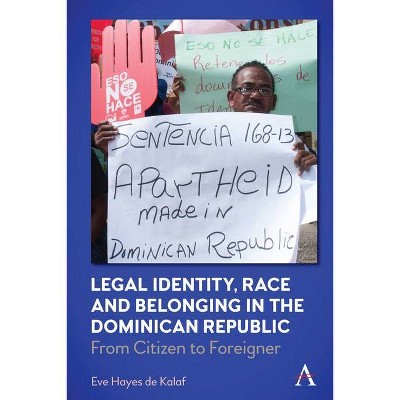
Legal Identity, Race and Belonging in the Dominican Republic - (Anthem Citizenship and National Identities) by Eve Hayes de Kalaf (Hardcover)
Similar Products





Products of same category from the store
All










Product info
<p/><br></br><p><b> About the Book </b></p></br></br><p>This book provides a cautionary tale regarding legal identity practices as promulgated by the World Bank, UN and Inter-American Development Bank. It warns that policies encouraging the en masse registration of native-born migrant-descended populations can also force the thorny question of nationality, unsettling long-established identities and entitlements. </p><p/><br></br><p><b> Book Synopsis </b></p></br></br><p>Legal identity is universal, transcending national and socioeconomic borders. It is a central tenet of the UN's 2030 SDGs and cuts across over 70 development indicators, including birth registration. Evidentiary proof of citizenship is now a necessary tool to ensure access to health, education and welfare services. As Laurence Chandy, director of Data, Research and Policy at the</p> <p>UN Children's Fund (UNICEF), recently stated: the prioritisation of documentation within global policy, including the transition from paper to digital identity systems, is 'one of the most under-appreciated revolutions in international development'. </p> <p>During a period of intense global political-economic reconfiguration, inter-governmental organisations, multi-lateral and national aid agencies have problematised under-documentation. They have contributed significant levels of financial and technical assistance to governments to improve civil registries and ensure that all citizens everywhere have their paperwork. Over this time, formal identification has come to be considered a 'prerequisite for development in the modern world' (Gelb and Clark, 2013). It is now essential to development strategy planning and assumed in both policy and practice to constitute a common good for all beneficiaries. </p> <p>With a focus on the Caribbean, this book highlights how identification practices as promulgated by the World Bank, United Nations (UN) and the Inter-American Development Bank can force the thorny question of nationality, unsettling long-established identities and entitlements. Notably, the book is the first to identify tensions in social policy over the use of social protection mechanisms promoting legal identity measures with disputes over race, national identity and belonging. The book illustrates how, while keen to follow the World Bank's lead in promoting a legal identity for all - not least to continue benefiting from external funding and support - the Dominican Republic balked at pressure to recognise the national status of persons of Haitian ancestry. It used social policy programmes and international donor funding to trace and register the national origins of persons of non-Dominican ancestry. This culminated in the now notorious 2013 Constitutional Tribunal ruling that retroactively stripped tens of thousands of persons of Haitian descent of their Dominican citizenship. Significantly, these measures not only affected undocumented or stateless populations - persons living at the fringes of citizenship - but also had a major impact on documented citizens already in possession of a state-issued birth certificate, national identity card and/or passport as Dominicans.</p><p/><br></br><p><b> Review Quotes </b></p></br></br><br><p>"An innovative look at the politics of legal citizenship in the Dominican Republic. Hayes de Kalaf's deft analysis shows how 'soft' strategies of legal exclusion by the Dominican state have come to replace the 'hard, ' problematic repression of the past." -- Ernesto Sagás, Colorado State University, US</p><br><br><p>"Dr. Hayes de Kalaf brilliantly exposes the exclusionary, discriminatory and racist practices taking place in the Dominican Republic, highlighting the struggles citizens born in the country are now facing as they battle with the state to acquire essential paperwork and obtain access to welfare, education and health services." -- Gibrán Cruz-Martínez, Institute of Public Goods and Policies, CSIC, Spain</p><br><br><p>"In this important book, Eve Hayes de Kalaf explores the murky discrepancies between citizenship and legal identity in a powerful interrogation of contemporary forms of statecraft that strip minoritized citizens of their legal status and render them stateless in the only country they have ever known. Focused on the predicament of native-born citizens of the Dominican Republic who have been branded as 'Haitians' and 'illegal immigrants, ' this book is a study with profound worldwide ramifications and crucial lessons for the study of citizenship, statelessness, and identity." -- Nicholas De Genova, University of Houston, US</p><br><br><p>Tracking the rise of identity systems technologies and their inevitable abuses, Dr Hayes de Kalaf unsettles the standard binary of migrant/citizen and by focusing on the case of the Dominican Republic, uncovers a growing threat to our planetary commonwealth. Brilliant and urgent, this is a book that belongs on the shelf of anyone interested in questions of national belonging - which is more or less everyone." -- Junot Díaz is the Pulitzer Prize-winning author of <em>The Brief Wondrous Life of Oscar Wao</em>, a MacArthur Fellow and professor at the Massachusetts Institute of Technology, US.</p><br><p/><br></br><p><b> About the Author </b></p></br></br><p>Eve Hayes de Kalaf is a research associate based at the School of Histories, Languages and Cultures, University of Liverpool and a fellow of the Institute of Latin American Studies, University of London.</p>
Price History
Cheapest price in the interval: 125 on November 8, 2021
Most expensive price in the interval: 125 on December 20, 2021
Price Archive shows prices from various stores, lets you see history and find the cheapest. There is no actual sale on the website. For all support, inquiry and suggestion messages communication@pricearchive.us