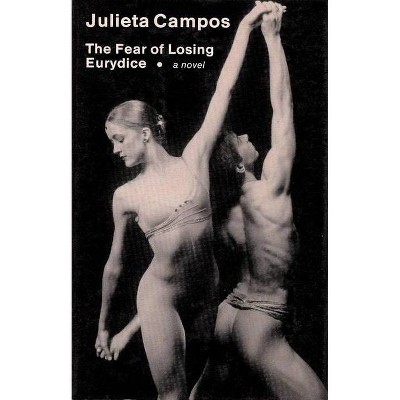
Fear of Losing Eurydice - by Julieta Campos (Paperback)
Similar Products






Products of same category from the store
All








Product info
<p/><br></br><p><b> About the Book </b></p></br></br>This lyrical novel by one of Mexico's leading women writers explores both desire and the desire to tell a love story. In an idle moment between grading assignments, a French teacher sitting in a cafe in a Caribbean seaport town sketches an island on his white napkin.<p/><br></br><p><b> Book Synopsis </b></p></br></br>This lyrical novel by one of Mexico's leading women writers explores both desire and the desire to tell a love story. In an idle moment between grading assignments, a French teacher sitting in a cafe in a Caribbean seaport town sketches an island on his white napkin. Like Proust's petite madeleine, the island opens up a host of images: "Island: the sum of all improbabilities; intoxicating improbability of fiction. Island: image of desire...All the islands formulated by human beings and all islands appearing on the maps comprise a single imaginary archipelago - the archipelago of desire." Monsieur N.'s original plan to use a Jules Verne novel about shipwrecked schoolboys as a translation exercise for his pupils becomes an obsession to collect every reference to islands he can find and to meditate on them in a diary of his imaginary travels - his Islandiary. Parallel to this quest is an archetypal love story that he begins writing in his notebook, printed in a narrow column with islands of quotations surrounding it. Voyaging and the quest for islands become a metaphor for the search for paradise, for the island as an imagined place where love achieves perfection. It also becomes a metaphor for writing: "Every text is an island."<p/><br></br><p><b> Review Quotes </b></p></br></br><br>A wildly lyrical love story in which [Campos] liberally uses allusions to, and quotations from, classical literature . . . The translation by Leland H. Chambers . . . is first rate.<br><br>By turns mesmerizing, funny, and somewhat precious, Cuban-Mexican Campos's newly translated work rejects novelistic techniques for a multilayered meditation on narration, fantasy, and dream.<br><br>Campos conducts a symphony of appropriated quotes. She composes the dictionary of love, she includes every age and every angle. She gives us flawless reproductions . . . Campos has my admiration for the extraordinary volume of research she has ingested, her mesmerizing control of the language and of techniques ranging from magic realism to metafiction.<br><br>Campos, like Orpheus, attempts to recover love from death by spinning constant literary re-presentations of the primordial utopia, of the original paradisiacal love between Eve and Adam . . . The novel is the desire, the eternal search for a utopia, transformed into writing about writing and, by extension, about Western cultures: art, drama, opera, film, music, geography, philosophy, and, above all, literature.<br><br>For Campos, words, islands, and desire are inextricably linked, and so they are in her fascinating book.<br><br>In addition to colorful, powerful images that leap off the page and make N's journey vivid, the reader is also treated to quotations from philosophical and literary texts that, printed in the margin of N's notebook, surround his writing like islands.<br><br>No ordinary love story, The Fear of Losing Eurydice is an investigation of writing, of reality, and of the transitory nature of love/desire. Quotes about islands as well as about desire from a dizzying number of sources flank the main text.<br><br>That the author is also a poetess is clear from this highly allusive and subtle work, wherein she plays with the idea of the Island as a paradigm of the human soul, the literary text and the exclusive relationship between two lovers. This duality is reflected by the 'story within a story' device used in the novel. Intriguing.<br><br>This delicate and lyrical novel by one of Mexico's leading authors interweaves many different strands of text with all the fluidity of dreams . . . Adventurous readers will find the challenge well worth undertaking.<br><br>This exceptional, allusive narrative reverie upon travel and romance will find an appreciative audience in those with a continental turn of mind. A fine introduction of this Latina novelist in North America.<br>
Price History
Price Archive shows prices from various stores, lets you see history and find the cheapest. There is no actual sale on the website. For all support, inquiry and suggestion messages communication@pricearchive.us