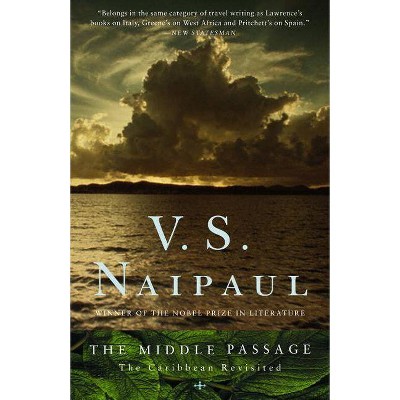
The Middle Passage - by V S Naipaul (Paperback)
Similar Products








Products of same category from the store
All









Product info
<p/><br></br><p><b> About the Book </b></p></br></br>Originally published: London: A. Deutsch, 1962.<p/><br></br><p><b> Book Synopsis </b></p></br></br>In 1960 the government of Trinidad invited V. S. Naipaul to revisit his native country and record his impressions. In this classic of modern travel writing he has created a deft and remarkably prescient portrait of Trinidad and four adjacent Caribbean societies-countries haunted by the legacies of slavery and colonialism and so thoroughly defined by the norms of Empire that they can scarcely believe that the Empire is ending.<br>In <b>The Middle Passage</b>, Naipaul watches a Trinidadian movie audience greeting Humphrey Bogart's appearance with cries of "That is man!" He ventures into a Trinidad slum so insalubrious that the locals call it the Gaza Strip. He follows a racially charged election campaign in British Guiana (now Guyana) and marvels at the Gallic pretension of Martinique society, which maintains the fiction that its roads are extensions of France's <i>routes nationales.</i> And throughout he relates the ghastly episodes of the region's colonial past and shows how they continue to inform its language, politics, and values. The result is a work of novelistic vividness and dazzling perspicacity that displays Naipaul at the peak of his powers.<p/><br></br><p><b> Review Quotes </b></p></br></br><br>"The coolest literary eye and the most lucid prose we have."-<i>The New York Times Book Review <p/></i>"Belongs in the same category of travel writing as Lawrence's books on Italy, Greene's on West Africa and Pritchett's on Spain." -<i>New Statesman</i> <p/> "Naipaul travels with the artist's eye and ear and his observations are sharply discerning." -Evelyn Waugh <p/>"Where earlier travelers enthused or recoiled, Mr. Naipaul explains. His tone is critical but humane, and he tempers his inevitable indignation with an admirable sense of comedy." -<i>The Observer</i> <p/>"Dazzling reportorial skills and a sharp historical mind." -<i>The New York Times</i><br><p/><br></br><p><b> About the Author </b></p></br></br>V.S. Naipaul was born in Trinidad in 1932. He came to England on a scholarship in 1950. He spent four years at University College, Oxford, and began to write, in London, in 1954. He pursued no other profession. <p/> His novels include <i>A House for Mr Biswas</i>, <i>The Mimic Men</i>, <i>Guerrillas</i>, <i>A Bend in the River</i>, and <i>The Enigma of Arrival</i>. In 1971 he was awarded the Booker Prize for <i>In a Free State</i>. His works of nonfiction, equally acclaimed, include <i>Among the Believers</i>, <i>Beyond Belief</i>, <i>The Masque of Africa</i>, and a trio of books about India: <i>An Area of Darkness</i>, <i>India: A Wounded Civilization</i> and <i>India: A Million Mutinies Now</i>. <p/> In 1990, V.S. Naipaul received a knighthood for services to literature; in 1993, he was the first recipient of the David Cohen British Literature Prize. He received the Nobel Prize in Literature in 2001. He lived with his wife Nadira and cat Augustus in Wiltshire, and died in 2018.
Price History
Cheapest price in the interval: 15.99 on October 22, 2021
Most expensive price in the interval: 15.99 on November 8, 2021
Price Archive shows prices from various stores, lets you see history and find the cheapest. There is no actual sale on the website. For all support, inquiry and suggestion messages communication@pricearchive.us