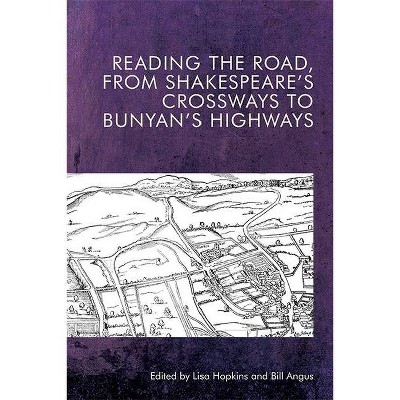
Reading the Road, from Shakespeare's Crossways to Bunyan's Highways - by Lisa Hopkins & Bill Angus (Paperback)
Similar Products

Products of same category from the store
All

Product info
<p/><br></br><p><b> About the Book </b></p></br></br><p>This book brings together thirteen essays, by both established and emerging scholars, which examine the most influential meanings of roads in early modern literature and culture. </p><p/><br></br><p><b> Book Synopsis </b></p></br></br><p><strong>Explores how cultural conceptions of mobility and the road contribute to identity and culture in early modern Britain</strong></p> <ul> <li>Opens new windows on early modern culture, subjectivity and perceptions around the experience of the road and how that shapes the idea of the road itself</li> <li>Offers insight into the ways both the bare boards of the stage and prose narratives were used to imagine road journeys and the intersections between public and private space</li> <li>Enhances historical understanding of the literal place of theatre in the road networks around early modern London</li> <li>Provides a crucial ligature in English literary and cultural history. The present plays and prose are prolegomena to the travel literature of Montagu, Swift, Boswell and Johnson in the Hebrides, Sterne's <i>Sentimental Journey</i>, Fielding's<i> Tom Jones</i>, and peripatetic Civil War narratives</li> <p></p></ul> <p></p> <p>This book brings together thirteen essays, by both established and emerging scholars, which examine the most influential meanings of roads in early modern literature and culture. Chapters develop our understanding of the place of the road in the early modern imagination and open various windows on a geography which may by its nature seem passing or trivial but is in fact central to all conceptions of movement. They also shed new light on perhaps the most astonishing achievement of early modern plays: their use of one small, bare space to suggest an amazing variety of physical and potentially metaphysical locations.</p><p/><br></br><p><b> From the Back Cover </b></p></br></br>Explores how cultural conceptions of mobility and the road contribute to identity and culture in early modern Britain This book brings together thirteen essays, by both established and emerging scholars, which examine the most influential meanings of roads in early modern literature and culture. Chapters develop our understanding of the place of the road in the early modern imagination and open various windows on a geography which may by its nature seem passing or trivial but is in fact central to all conceptions of movement. They also shed new light on perhaps the most astonishing achievement of early modern plays: their use of one small, bare space to suggest an amazing variety of physical and potentially metaphysical locations. Lisa Hopkins is Professor of English at Sheffield Hallam University. Bill Angus is Lecturer in Early Modern Literature at Massey University in New Zealand.<p/><br></br><p><b> About the Author </b></p></br></br><p>Lisa Hopkins is Professor of English at Sheffield Hallam University and co-editor of Shakespeare, the journal of the British Shakespeare Association. She has a longstanding interest in Marlowe and her previous publications include Christopher Marlowe: A Literary Life (Palgrave, 2000) and Christopher Marlowe: An Author Chronology (Palgrave, 2005). She is a vice-president of the Marlowe Society and a previous joint winner of the Hoffman Award for Distinguished Publication on Christopher Marlowe. <p>Bill Angus is a Senior Lecturer in Early Modern Literature at Massey University, New Zealand. His main research interest has been in metadrama and the material conditions of its provenance. His first two monographs are <i>Metadrama and the Informer in Shakespeare and Jonson</i> (Edinburgh University Press, 2016), and <i>Intelligence and Metadrama in the Early Modern Theatre </i> (EUP, 2018). He has also published on subjects ranging from early modern religious artefacts to the historical roots of the mythology of popular music.<p>
Price History
Price Archive shows prices from various stores, lets you see history and find the cheapest. There is no actual sale on the website. For all support, inquiry and suggestion messages communication@pricearchive.us