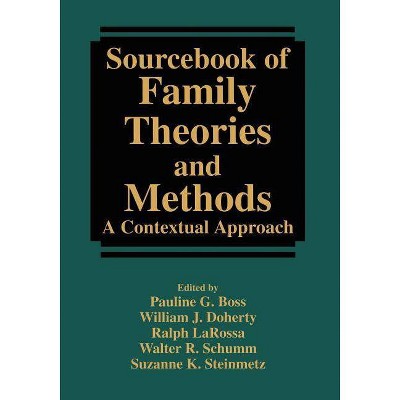
Sourcebook of Family Theories and Methods - by Pauline Boss & William J Doherty & Ralph Larossa & Walter R Schumm & Suzanne K Steinmetz (Paperback)
Similar Products


Products of same category from the store
All






Product info
<p/><br></br><p><b> About the Book </b></p></br></br><p>This book traces the development of various family theories and methods within the context of the social values, technological changes, and political events of the twentieth century. Multicultural dimensions are emphasized throughout.</p><p/><br></br><p><b> Book Synopsis </b></p></br></br>Origins We call this book on theoretical orientations and methodological strategies in family studies a sourcebook because it details the social and personal roots (i.e., sources) from which these orientations and strategies flow. Thus, an appropriate way to preface this book is to talk first of its roots, its beginnings. In the mid 1980s there emerged in some quarters the sense that it was time for family studies to take stock of itself. A goal was thus set to write a book that, like Janus, would face both backward and forward a book that would give readers both a perspec tive on the past and a map for the future. There were precedents for such a project: The Handbook of Marriage and the Family edited by Harold Christensen and published in 1964; the two Contemporary Theories about theFamily volumes edited by Wesley Burr, Reuben Hill, F. Ivan Nye, and Ira Reiss, published in 1979; and the Handbook of Marriage and the Family edited by Marvin Sussman and Suzanne Steinmetz, then in production.<p/><br></br><p><b> From the Back Cover </b></p></br></br><p>Now in softcover, the Sourcebook of Family Theories and Methods distills nearly a century of theories and therapies into one comprehensive volume. This unique sociohistorical account of family studies traces the development of various theories and methods within the sociopolitical context of the twentieth century, giving readers a practical balance of scientific and real-world perspective.</p> <p></p> <p>Contributors review each theory and method in terms of its origins, core assumptions, applications, and links to previous and successive theories and methods. Specific chapters provide in-depth applications with couples, families, step and blended families, minorities, families with histories of violence, and families facing chronic illness, as well as potential uses in policy, education, or further research. In this way, readers may find new ideas and possibilities in older or less familiar schools of thought. At the same time, the book offers the foundation for the future of the field.</p> <p></p> <p>A sampling of the coverage: </p> <ul> <p> <li>Systems theory.</li> <p></p> <p> <li>Human ecology theory.</li> <p></p> <p> <li>Life course perspectives.</li> <p></p> <p> <li>Social-cognitive-behavioral theory.</li> <p></p> <p> <li>Feminist theory.</li> <p></p> <p> <li>Theories derived from family therapy.</li> <p></p> <p> <li>Biosocial theory.</li> <p></p> <p> <li>Ethnomethodology.</li> <p></p></ul> <p></p> <p>A historical reference that doubles as a contemporary idea book, the Sourcebook of Family Theories and Methods belongs in the libraries of family therapists and psychologists, social workers, and sociologists specializing in families. Policy analysts in this critical area should find the Sourcebook significant reading as well. </p>
Price History
Price Archive shows prices from various stores, lets you see history and find the cheapest. There is no actual sale on the website. For all support, inquiry and suggestion messages communication@pricearchive.us