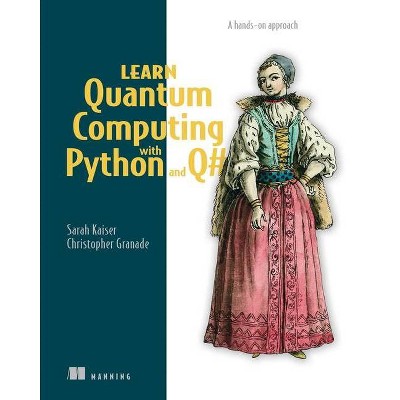
Learn Quantum Computing with Python and Q# - by Sarah C Kaiser & Christopher Granade (Paperback)
Similar Products
Products of same category from the store
All

Product info
<p/><br></br><p><b> About the Book </b></p></br></br>"For software developers. No prior experience with quantum computing required"--Back cover.<p/><br></br><p><b> Book Synopsis </b></p></br></br><b><i>Learn Quantum Computing with Python and Q#</i> introduces quantum computing from a practical perspective.</b> <p/><b>Summary</b> <p/> <i>Learn Quantum Computing with Python and Q#</i> demystifies quantum computing. Using Python and the new quantum programming language Q#, you'll build your own quantum simulator and apply quantum programming techniques to real-world examples including cryptography and chemical analysis. <p/>Purchase of the print book includes a free eBook in PDF, Kindle, and ePub formats from Manning Publications. <p/><b>About the technology</b> <p/>Quantum computers present a radical leap in speed and computing power. Improved scientific simulations and new frontiers in cryptography that are impossible with classical computing may soon be in reach. Microsoft's Quantum Development Kit and the Q# language give you the tools to experiment with quantum computing without knowing advanced math or theoretical physics. <p/><b>About the book</b> <p/><i>Learn Quantum Computing with Python and Q#</i> introduces quantum computing from a practical perspective. Use Python to build your own quantum simulator and take advantage of Microsoft's open source tools to fine-tune quantum algorithms. The authors explain complex math and theory through stories, visuals, and games. You'll learn to apply quantum to real-world applications, such as sending secret messages and solving chemistry problems. <p/><b>What's inside</b> <p/> The underlying mechanics of quantum computers<br> Simulating qubits in Python<br> Exploring quantum algorithms with Q#<br> Applying quantum computing to chemistry, arithmetic, and data <p/><b>About the reader</b> <p/>For software developers. No prior experience with quantum computing required. <p/><b>About the author</b> <p/><b>Dr. Sarah Kaiser</b> works at the Unitary Fund, a non-profit organization supporting the quantum open-source ecosystem, and is an expert in building quantum tech in the lab<b>. Dr. Christopher Granade</b> works in the Quantum Systems group at Microsoft, and is an expert in characterizing quantum devices. <p/><b>Table of Contents</b> <p/>PART 1 GETTING STARTED WITH QUANTUM<br> 1 Introducing quantum computing<br> 2 Qubits: The building blocks<br> 3 Sharing secrets with quantum key distribution<br> 4 Nonlocal games: Working with multiple qubits<br> 5 Nonlocal games: Implementing a multi-qubit simulator<br> 6 Teleportation and entanglement: Moving quantum data around<br> PART 2 PROGRAMMING QUANTUM ALGORITHMS IN Q#<br> 7 Changing the odds: An introduction to Q#<br> 8 What is a quantum algorithm?<br> 9 Quantum sensing: It's not just a phase<br> PART 3 APPLIED QUANTUM COMPUTING<br> 10 Solving chemistry problems with quantum computers<br> 11 Searching with quantum computers<br> 12 Arithmetic with quantum computers<p/><br></br><p><b> About the Author </b></p></br></br><b>Dr. Sarah Kaiser</b> works at the Unitary Fund, a non-profit organization supporting the quantum open-source ecosystem, and is an expert in building quantum tech in the lab<b>.</b> <p/>Christopher Granade completed his PhD in physics (quantum information) at the University of Waterloo's Institute for Quantum Computing, and now works in the Quantum Architectures and Computation (QuArC) group at Microsoft. He works in developing the standard libraries for Q# and is an expert in the statistical characterization of quantum devices from classical data. Previously, Christopher helped Scott Aaronson prepare lectures into his recent book, Quantum Computing Since Democritus.
Price History
Price Archive shows prices from various stores, lets you see history and find the cheapest. There is no actual sale on the website. For all support, inquiry and suggestion messages communication@pricearchive.us