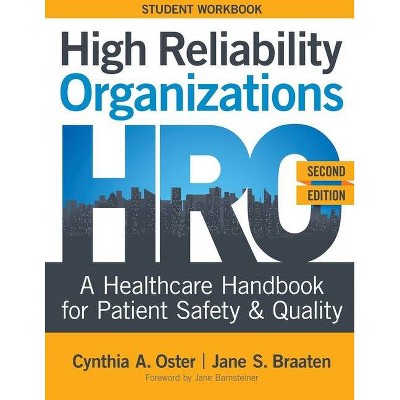
High Reliability Organizations, Second Edition - STUDENT WORKBOOK - 2nd Edition by Cynthia A Oster & Jane S Braaten (Paperback)
Similar Products







Products of same category from the store
All







Product info
<p/><br></br><p><b> About the Book </b></p></br></br><p>The purpose of this workbook is to provide learning activities that relate to each chapter in the the second edition of <em>High Reliability Organizations</em>. </p><p/><br></br><p><b> Book Synopsis </b></p></br></br><p>ABOUT THE STUDENT WORKBOOK</p><p>As a student in a healthcare profession, you have probably heard of the concept of high reliability as a means to reduce harm, enhance quality, and improve outcomes. Patient safety and quality are of increasing importance to consumers, payers, providers, and organizations. As a large majority of the workforce, nurses are on the front lines of the delivery and provision of safe and effective care. The quest for high reliability must permeate an organization by way of leadership commitment, a culture of safety, continuous quality improvement, and every person's focus within the organization. This student workbook is designed as a companion to the primary textbook, High Reliability Organizations: A Healthcare Handbook for Patient Safety & Quality (2nd ed.), which explains how high reliability contributes to organizational quality and safety, recommends quality and safety activities based on high reliability principles, and integrates high reliability principles into healthcare practice.</p><p><br></p><p>PURPOSE AND STRUCTURE</p><p>The purpose of this workbook is to provide learning activities that relate to each chapter in the book. These learning activities introduce students to high reliability, explain the concepts of high reliability and high reliability organizations (HROs), provide examples of what the concepts would look like in</p><p>everyday practice, and describe the information and tools nurses and other healthcare providers need for the organization to become an HRO. The first 26 chapters provide one accompanying learning activity, whereas the last five chapters provide context for the summative or final learning activity.</p><p>Every learning activity reflects the content of its accompanying chapter. Students should read the chapter and supplemental materials and, if specified, focus on certain sections within the chapter prior to completing an exercise. Students may complete all these learning activities, but some instructors may choose only one or two from each chapter that meet the objectives of a particular course. Each learning activity begins with objectives, contains accompanying resource material or additional external resources, and has learning activity exercise-specific instructions. Nurses represent the majority of healthcare workers and are on the front lines of delivery and provision of safe and effective care. As a result, nurses are ideally situated to drive the mission to achieve high reliability in healthcare. It is our hope that the student workbook will prepare you to apply HRO principles to patient safety and quality problems in your place of practice because we all benefit from a safer healthcare environment.</p><p/><br></br><p><b> Review Quotes </b></p></br></br><br><p><em>"Enhancing your people's adaptive capacity on the front lines makes all the difference-that is where resilience gets made and eroded. Healthcare systems, however, have a hard time getting that message through. Adding protocols, guidelines, policies, processes, and structures is easy, Oster and Braaten observe, but we should instead be understanding and supporting how practitioners on the front lines make successful outcomes occur in complex, dynamic environments. In this new edition of their push to change patient safety thinking, they have an A-list lineup of contributors exploring just how that might work in their (and your) area of patient care."</em></p><p>Sidney W. A. Dekker, MA, MSc, PhD</p><p>Professor</p><p>Safety Science Innovation Lab</p><p>Griffith University, Australia, and Delft University, the Netherlands</p><p> </em></p><p>"Oster and Braaten have captured the essence of high reliability organizations, and this highly readable guide inspires organizations to do the right things to protect their patients while providing them with the tools to do so. The authors' experiences in these fields show, as each chapter is filled with attention to human aspects of high reliability as well as practical recommendations for creating high performance. These authors-themselves considered experts in the field-have assembled an impressive group of contributors to create this comprehensive text that answers both the 'why' and the 'how' of quality and patient safety efforts. They bring a fresh, contemporary approach to a complex organizational challenge and a guide to achieving the state of high reliability, even in challenging times."</em></p><p>Janet Houser, PhD, RN</p><p>Provost, Regis University, Denver</p><p>Author, Nursing Research: Reading, Using and Creating Evidence, </em>5th Edition </p><p><em> </em></p><p><em>"This is an outstanding resource for anyone interested in the theory and practice of high reliability organizing in healthcare. The 32 chapters in this thoughtfully organized handbook present a wide-ranging mix of theoretical frameworks, practices, and implementation strategies. The attention to the critical role of leadership, culture, and context in enhancing the reliability of healthcare delivery is especially noteworthy. This timely update is a welcome addition to the literature."</em></p><p>Rangaraj Ramanujam, PhD</p><p>Richard M. and Betty Ruth Miller Professor of Healthcare Management</p><p>Owen Graduate School of Management</p><p>Vanderbilt University</p><p><em> </em></p><p><em>"The global quest to prevent patient harm and improve care quality and safety is paramount across all healthcare delivery settings. The second edition </em>of<em> </em>High Reliability Organizations<em> elucidates the connection among human and organizational factors, effectively integrating theory with pragmatic examples of health systems' progress and challenges. Shifting practice paradigms require effective use of innovation and technology to advance and sustain improved patient safety outcomes. Noteworthy new information includes content on the COVID-19 pandemic, resilience-building strategies, ambulatory care delivery, and telehealth considerations."</em></p><p>Ann Scott Blouin, PhD, RN, LFACHE</p><p>President, PSQ Advisory, Ltd.</p><p>Board and Executive Committee Member, Institute for Healthcare Improvement</p><p>Assistant Professor, Marcella Niehoff School of Nursing, Loyola University Chicago</p><br>
Price History
Price Archive shows prices from various stores, lets you see history and find the cheapest. There is no actual sale on the website. For all support, inquiry and suggestion messages communication@pricearchive.us