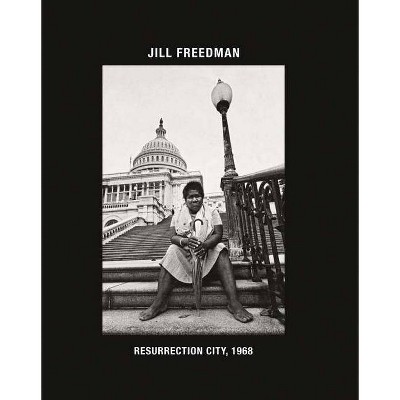
Jill Freedman: Resurrection City, 1968 - by Steven Kasher (Hardcover)
Similar Products








Products of same category from the store
All








Product info
<p/><br></br><p><b> Book Synopsis </b></p></br></br><p><strong>The climax of Martin Luther King's Poor People's Campaign</strong></p><p>Published in 1970, Jill Freedman's <i>Old News: Resurrection City</i> documented the culmination of the Poor People's Campaign of 1968, organized by Martin Luther King, Jr. and the Southern Christian Leadership Conference, and carried out under the leadership of Ralph Abernathy in the wake of Dr King's assassination. Three thousand people set up camp for six weeks in a makeshift town that was dubbed Resurrection City, and participated in daily protests. Freedman lived in the encampment for its entire six weeks, photographing the residents, their daily lives, their protests and their eventual eviction.</p><p>This new 50th-anniversary edition of the book reprints most of the pictures from the original publication, with improved printing and a more vivid design. Alongside Freedman's hard-hitting original text, two introductory essays are included, by John Edwin Mason, historian of African history and the history of photography at the University of Virginia, and by Aaron Bryant, Curator of Photography at the National Museum of African American History and Culture.</p><p>The photographs of <b>Jill Freedman</b> (born 1939) are held in the permanent collections of major art institutions including The Museum of Modern Art, New York; the International Center of Photography, New York; the New York Public Library; the Jewish Museum, New York; the George Eastman House, Rochester; the Smithsonian American Art Museum, Washington, DC; and the Museum of Fine Arts, Houston. She has had solo exhibitions at numerous museums, including the International Center of Photography, New York; the Museum of Contemporary Photography, Chicago; and the George Eastman House. Seven monographs of her work have been published: <i>Old News: Resurrection City</i> (Grossman, 1970); <i>Circus Days</i> (Harmony, 1975); <i>Firehouse</i> (Doubleday, 1977); <i>Street Cops</i> (Harper & Row, 1982); <i>A Time That Was: Irish Moments</i> (Friendly Press, 1987); <i>Jill's Dogs</i> (Pomegranate Art Books, 1993); and <i>Ireland Ever</i> (Harry Abrams, 2004). Freedman is represented by Steven Kasher Gallery.</p><p/><br></br><p><b> Review Quotes </b></p></br></br><br>A series of images of the encampment of the dispossessed built on the Mall...--Jon Meacham "New York Times: Book Review"<br><br>Her images and texts are frank and unromantic...but they show heroism and pride and defiance.-- "PDN (Photo of the Day)"<br><br>If you forget about things like traffic lights and dress shops and cops, Resurrection City was pretty much just another city. Crowded. Hungry. Dirty. Gossipy. Beautiful. It was the world, squeezed between flimsy snow fences and stinking humanity. There were people there who'd give you the shirt off their backs, and others who'd kill you for yours. And every type in between. Just a city.-- "The Paris Review"<br><br>It finds American society cosmetically altered, but fundamentally similar.-- "PDN's Notable Photo Books of 2018"<br><br>This 50th-anniversary edited edition of Freedman's photographs is a master-piece.-- "Kirkus"<br><br>her black-and-white prints are honest and stirring portraits of the ordinary people at the heart of this historic uprising.--Rebecca Bengal "Vulture"<br><br>Freedman never represents her subjects as victims, instead contrasting Washington politicians' indifference with the marcher's quiet determination to be seen.--Anne Doran "Collector Daily"<br><br>Her powerful documentary book first appeared in 1971; the current reissue includes many of the original photographs ...all supplemented by Ms. Freedman's street-wise annotations. The reissue is timely. Inequity is starker than ever.--Holland Cotter "The New York Times"<br><br>The images...portray the diversity of the protests' participants and capture the events on scales both epic and intimate [...] In Mason's view, Freedman's position as a white photographer does not make the images feel insincere or voyeuristic. "She walked the walk," he says. "She had quit her job, she was virtually penniless, [and] she was not getting paid for the photos" as she took them. He adds that her respect for the subjects also comes through clearly: They're not "cardboard heroes" with limitless strength. Instead, we see the protesters tired and frustrated.--Matthew Taub "Atlas Obscura"<br><br>These images depict solidarity among activists of all races. They reveal the dignity and courage of parents determined to provide their children with a better life.--Maurice Berger "New York Times"<br><br>This powerful work of documentary photography captures the momentum of the civil rights movement through one of its lesser known demonstrations....In black-and white photos, Freedman captures the mud and grime of the encampment. While there are signs of poverty throughout her photographs--an elderly woman wearing paper bags on her feet, a toothless man smiling at the camera--more striking is the sense of camaraderie among the residents, as seen in the photos of drum circles, kids wrestling with tire swings, groups of women sitting cross-legged on the lawn while singing and clapping their hands.--Alison Green "Publisher's Weekly"<br>
Price History
Cheapest price in the interval: 28.99 on October 22, 2021
Most expensive price in the interval: 28.99 on November 8, 2021
Price Archive shows prices from various stores, lets you see history and find the cheapest. There is no actual sale on the website. For all support, inquiry and suggestion messages communication@pricearchive.us