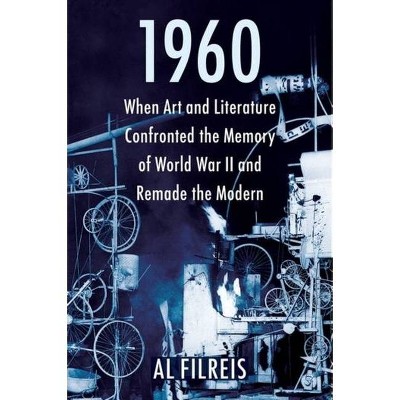
1960 - by Al Filreis (Hardcover)
Similar Products
Products of same category from the store
All


Product info
<p/><br></br><p><b> About the Book </b></p></br></br>Al Filreis recasts 1960 as a turning point to offer a groundbreaking account of postwar culture. He examines an eclectic group of artistic, literary, and intellectual figures who strove to create a new language to reckon with the trauma of World War II and to imagine a new world.<p/><br></br><p><b> Book Synopsis </b></p></br></br>In 1960, when World War II might seem to have been receding into history, a number of artists and writers instead turned back to it. They chose to confront the unprecedented horror and mass killing of the war, searching for new creative and political possibilities after the conservatism of the 1950s in the long shadow of genocide. <p/>Al Filreis recasts 1960 as a turning point to offer a groundbreaking account of postwar culture. He examines an eclectic group of artistic, literary, and intellectual figures who strove to create a new language to reckon with the trauma of World War II and to imagine a new world. Filreis reflects on the belatedness of this response to the war and the Holocaust and shows how key works linked the legacies of fascism and antisemitism with American racism. In grappling with the memory of the war, he demonstrates, artists reclaimed the radical elements of modernism and brought forth original ideas about testimony to traumatic history. <p/><i>1960</i> interweaves the lives and works of figures across high and popular culture--including Chinua Achebe, Hannah Arendt, James Baldwin, Amiri Baraka, Paul Celan, John Coltrane, Frantz Fanon, Roberto Rossellini, Muriel Rukeyser, Rod Serling, and Louis Zukofsky--and considers art forms spanning poetry, fiction, memoir, film, painting, sculpture, teleplays, musical theater, and jazz. A deeply interdisciplinary cultural, literary, and intellectual history, this book also offers fresh perspective on the beginning of the 1960s.<p/><br></br><p><b> Review Quotes </b></p></br></br><br><i>1960</i> offers a provocative and vivid intellectual history from a literary perspective. Reading works as diverse as John Coltrane's<i> My Favorite Things </i>and Jackson Mac Low's aleatory poetry as part of the belated processing of WWII traumas, it asks us to reconsider the origins, references, and trajectories of the post-war avant-gardes.--Craig Dworkin, author of <i>Dictionary Poetics: Toward a Radical Lexicography</i><br><br>This brilliantly syncretic book confronts the repression of World War II in American culture, circa 1960. Filreis thinks through a constellation of songs, literature, poetry, and films, each pierced by the war. His linked essays show how great art is not only ethically necessary but also a source of endless pleasure. <i>1960</i> is a tour de force of critical intelligence.--Charles Bernstein, author of <i>Pitch of Poetry</i><br><br>Tightly focused on work done within the year of its title, Al Filreis's <i>1960 </i>offers a compelling argument for the ways artists processing the memory of mass trauma of World War II turned to innovation and re-invention as a means of recovery. Filreis has managed a rare accomplishment-writing a profound work of historical analysis that has deep implications for ideas shaping our lives today.--Johanna Drucker, author of <i>Iliazd: Meta-Biography of a Modernist</i><br><br>Al Filreis adds 1960s to the years that matter in <i>1960: When Art and Literature Confronted the Memory of World War II and Remade the Modern</i>. The story he tells about the art, literature, and film of that year is complicated, one less utopian than many presume, one defined by the despair of World War II, one where it matters that Celan and Baldwin gave talks on the same day in October of 1960. This is a beautiful and complicated book, full of detailed readings of minor and major figures, one that will be known for reconfiguring and contextualizing the avant garde and experimental traditions of that era.--Juliana Spahr, author of <i>Du Bois's Telegram: Literary Resistance and State Containment</i><br><p/><br></br><p><b> About the Author </b></p></br></br>Al Filreis is Kelly Family Professor of English, director of the Center for Programs in Contemporary Writing, codirector of PennSound, and founder and faculty director of the Kelly Writers House at the University of Pennsylvania. His books include <i>Modernism from Right to Left: Wallace Stevens, the Thirties, and Literary Radicalism</i> (1994) and <i>Counter-Revolution of the Word: The Conservative Attack on Modern Poetry, 1945-60</i> (2008), and he is the host of the podcast <i>PoemTalk</i>.
Price History
Price Archive shows prices from various stores, lets you see history and find the cheapest. There is no actual sale on the website. For all support, inquiry and suggestion messages communication@pricearchive.us