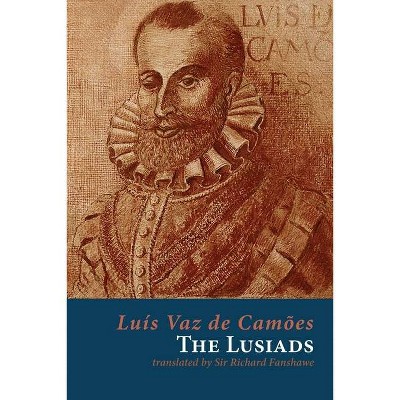
The Lusiads - by Luis Vaz De Camoes & Richard Fanshawe (Paperback)
Similar Products





Products of same category from the store
All






Product info
<p/><br></br><p><b> About the Book </b></p></br></br><p><em>The Lusiads</em> is Camoes' 16th-century masterpiece and to all intents and purposes his attempt at a Portuguese founding narrative along the lines of the <em>Aeneid</em>, dealing with the rise of Portugal as a maritime power. </p><p/><br></br><p><b> Book Synopsis </b></p></br></br><p>Camões (ca.1524/25-1580) is the national poet of Portugal, with a status in the Lusophone world akin to that of Shakespeare, Dante, Cervantes and Goethe elsewhere. A wonderful lyric poet, and also an occasional dramatist, his masterpiece is <em>Os Lusíadas</em> (The Lusiads), an epic poem on the beginnings of the Portuguese maritime empire, for which the author himself had fought as a common soldier - in North Africa - where he lost an eye in battle, in India, in southern Africa, the Red Sea, India and Macau - where the grotto in which he wrote some of the poem is a tourist attraction. As Dante took Virgil as his guide in the <em>Divine Comedy</em>, so Camões uses the great navigator, Vasco da Gama, as his tutelary spirit, while also aping Virgil's approach in the <em>Aeneid</em>, fashioning a national epic on the empire's origins in much the same way as Virgil had done for the Rome of Augustus.</p><p> The translation here, dating from 1655, is one of the great translations of the 17th century, made while Sir Richard Fanshawe (1608-1666), a supporter of Charles I and Charles II, was under house arrest during the Cromwellian inter-regnum. Fanshawe also translated two Spanish plays and a number of Spanish sonnets from the period around 1600-1630, with some of the finest being from the baroque master Luís de Góngora. Unlike many of his successors, Fanshawe tries to stay close to the original, occasionally at the cost of having to twist the English to fit the rhyme and metre, the target language having, even in this more flexible era, far fewer resources for rhyme than the Portuguese. The results, nonetheless, are something of a monument, giving voice to a very long and complex poem and making it work, <em>almost</em>, as an English epic. Fanshawe, when not at his desk, was an accomplished diplomat, having served in the Madrid embassy and, after the Restoration, as Ambassador in Lisbon, where he negotiated the marriage of Charles II to Catherine of Braganza.</p><p><br></p>
Price History
Price Archive shows prices from various stores, lets you see history and find the cheapest. There is no actual sale on the website. For all support, inquiry and suggestion messages communication@pricearchive.us