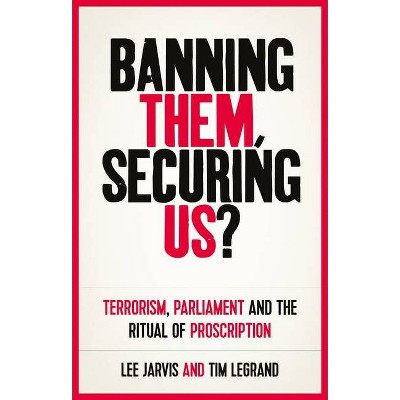
Banning them, securing us? - (Manchester University Press) by Lee Jarvis & Tim Legrand (Hardcover)
Similar Products

Products of same category from the store
All

Product info
<p/><br></br><p><b> About the Book </b></p></br></br>Jarvis and Legrand explore the banning of terrorist organisations in liberal democratic states such as the United Kingdom. This process, they argue, is far more a ritualized performance of national identity, than it is a meaningful contribution to national security.<p/><br></br><p><b> Book Synopsis </b></p></br></br><p><em>Banning them, securing us?</em> explores the proscribing - or banning - of terrorist organisations within the United Kingdom across a period of twenty years. The process of banning specific organisations, Jarvis and Legrand argue, is as much a ritualistic performance of liberal democracy as it is a technique for increasing national security from the threat posed by terrorism. Characterised by a repetitive script, an established cast of characters and a predictable outcome, this ritual provides an important contribution to the construction of Britain as a liberal, democratic, moderate space. It does so, paradoxically, through extending the reach of a power that has limited political or judicial oversight and considerable implications for rights, freedoms and political participation. Offering a discursive analysis of all British Parliamentary debates on the banning of terrorist organisations since the introduction of Britain's current proscription regime in 2000, this book provides the first sustained treatment of this counter-terrorism power in the United Kingdom and beyond.</p><p/><br></br><p><b> From the Back Cover </b></p></br></br><i>Banning them, securing us?</i> explores the proscribing - or banning - of terrorist organisations within the United Kingdom across a period of twenty years. The process of banning specific organisations, Jarvis and Legrand argue, is as much a ritualistic performance of liberal democracy as it is a technique for increasing national security from the threat posed by terrorism. Characterised by a repetitive script, an established cast of characters and a predictable outcome, this ritual provides an important contribution to the construction of Britain as a liberal, democratic, moderate space. It does so, paradoxically, through extending the reach of a power that has limited political or judicial oversight and considerable implications for rights, freedoms and political participation. Offering a discursive analysis of all British Parliamentary debates on the banning of terrorist organisations since the introduction of Britain's current proscription regime in 2000, this book provides the first sustained treatment of this counter-terrorism power in the United Kingdom and beyond.<p/><br></br><p><b> Review Quotes </b></p></br></br><br>'A fresh look at proscription by focusing on Parliamentary debates. Essential reading.' Kent Roach, Professor of Law, University of Toronto 'An important subject, thoroughly and provocatively analysed. A fascinating book.' Richard English, Professor of Politics, Queen's University Belfast and author of <i>Does Terrorism Work? A History</i> 'This book significantly augments the important legal literature on proscription with outstanding insights within political science and security studies, based on UK Parliamentary processes during the past two decades.' Clive Walker, Professor Emeritus of Criminal Justice Studies, University of Leeds 'Jarvis and Legrand offer a comprehensive and historically rich analysis of proscription in the UK, showing how Parliamentary proscription debates mobilise notions of 'us' and 'them' in problematic ways.' Marieke de Goede, Professor of Political Science, University of Amsterdam and author of <i>Speculative Security</i><br><p/><br></br><p><b> About the Author </b></p></br></br>Lee Jarvis is Professor of International Politics at the University of East Anglia Tim Legrand is Associate Professor of International Security at the University of Adelaide
Price History
Price Archive shows prices from various stores, lets you see history and find the cheapest. There is no actual sale on the website. For all support, inquiry and suggestion messages communication@pricearchive.us