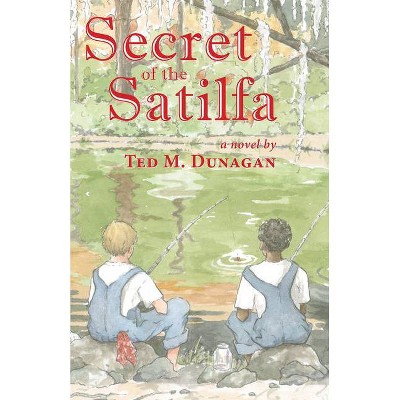
Yellow Watermelon - by Ted M Dunagan (Paperback)

Similar Products


Products of same category from the store
All
Product info
<p/><br></br><p><b> About the Book </b></p></br></br>Growing up in poverty-stricken, racially segregated, rural Alabama in the late 1940s, a white boy named Ted and a black boy named Poudlum become secret friends, join forces to integrate the cotton field laborers, and try to stop evil forces from depriving Poudlum's family of their property and livelihood.<p/><br></br><p><b> Book Synopsis </b></p></br></br><b>Winner of the Georgia Author of the Year Award for Young Adult Fiction</b> <p/><b>A Georgia Center for the Book "Books All Young Georgians Should Read" Selection</b> <p/>In the best Southern literary tradition, <em>A Yellow Watermelon</em> explores poverty and racial segregation through the eyes of an innocent boy. In rural south Alabama in 1948, whites picked on one side of the cotton field and blacks on the other. Where the fields meet, twelve-year-old Ted meets Poudlum, a black boy his own age, who teaches him how to endure the hard work while they bond and go on to integrate the field. Through Poudlum and Jake, an escaped black convict, Ted learns of evil forces gathering to deprive Poudlum's family of their property and livelihood. The white boy and the black boy encounter danger and suspense while executing a plan to save Poudlum's family, set Jake onto a river of freedom, and discover a great, yet simple secret of enlightenment.<p/><br></br><p><b> Review Quotes </b></p></br></br><br><em>A Yellow Watermelon</em> is reminiscent of some of the best Southern books. <em>Huckleberry Finn</em> by Mark Twain immediately comes to mind, as does Harper Lee's <em>To Kill a Mockingbird</em>, both of which are drenched in the segregationist attitudes of the region. -- <b>Michelle Eubanks</b>, <em>Florence Times Daily</em><br><br><em>A Yellow Watermelon</em> reminds me of <em>To Kill a Mockingbird</em> and <em>Huckleberry Finn</em> in that it is a great read with engaging, memorable characters and wonderful boyhood stories that also tell volumes about the small town South of the 1940s. Read it for fun, but soak up the history. -- <b>Billy Moore</b>, author of <em>Cracker's Mule</em><br><br>[<em>A Yellow Watermelon</em>] has some nice characterization and local color--what folks eat, work songs in the field, ordering school clothes from the Sears and Roebuck catalog--but also plenty of action. I think there is more than enough plot action to satisfy a young reader. -- <b>Don Noble</b>, Alabama Public Radio<br><br>[<em>A Yellow Watermelon</em>] is rich in history and told in beautiful prose. The engaging story draws reader in and reminding them of the terrible treatment of blacks in the South prior to the civil rights movement. The action and suspense of the story line will surely hook even the most reluctant reader. -- <b><em>The Crimson Review</em></b><br><br>If you have a young adult in your house who likes to read, or one who doesn't like to read but who you think might if it is the right book, here is what you are looking for. Ted Dunagan. <em>A Yellow Watermelon</em>. It is a dandy. -- <b>Dr. Harvey Jackson III</b>, <em>The Anniston Star</em><br><br>In <em>A Yellow Watermelon</em>, Ted refuses to be an observer of life in rural Alabama of 1949. He's in the middle of the action, looking and listening and thinking. He learns secrets and stirs up dangers that force him to take a courageous stand against long established customs that are unfair and dishonest. What can an "almost twelve-year-old" do to make a difference? With the help of forbidden friends, Ted's inventive solutions will surprise the reader and keep the pages turning to the tasty end of the story. -- <b>Aileen Kilgore Henderson</b>, author of <em>Hard Times for Jake Smith</em><br><br>In <em>Yellow Watermelon</em>, Ted Dunagan convincingly captures the South of the late 1940s. In a moving story he shows through the experience of a boy how friendship can triumph over prejudice. Good reading! -- <b>Faye Gibbons</b>, author of <em>Night in the Barn</em><br><br>It's a fine, well-told tale of friendship between two smart, likable boys--one white, one black. In a scene akin to Deborah Wiles's <em>Freedom Summer</em> (2001), anticipating the civil rights movement, Ted tells Poudlum, "And someday you gonna be able to walk in that drug store, sit down and have yourself some ice cream. You know what else, one day we'll be able to go to school together, too." A memorable, generous-hearted tale. -- <b><em>Kirkus Reviews</em></b><br><br>Readers of <em>A Yellow Watermelon</em> will be steeped in the rich and contradictory world that was the South of the 1940s. Twelve-year-old Ted Dillon, who has never seen more of the world than the scant few miles around his home ... also carries the fear that his father will soon lose his job at the mill, along with the growing realization that for the black members of his community there is little hope and no equality. With deft and precise language Ted Dunagan tells a story that is both beautifully wrought and unsparing in its portrayal of all that was good and bad in Dixie. -- <b>Adrian Fogelin</b>, author of <em>Crossing Jordan</em><br><br>Suspense and danger scar the peaceful landscape of rural Alabama as we view it through Ted's twelve-year-old eyes. <em>A Yellow Watermelon</em> is a touching story. It portrays ordinary individuals who take extraordinary measures to battle evil. Maybe it will also help young adults identify dangerous Mr. Creels among them! -- Anne Dalton, author of <em>Dream Ghost</em><br><br>The novel's plot--and Dunagan's--are daring, intricate, suspenseful, and executed with style and vigor. Thus, the adventure story, and it is a very satisfying one. -- <b>Alabama Writers Forum</b><br><br>With its colorful prose, exciting plot, and rich historical context, this novel successfully manages to embed an important reminder of the deplorable treatment of blacks in the deep South before the civil rights era into an entertaining, action-packed story. Thoroughly ingrained into the plotline are some important economic principles related to poverty, decent wages, and property rights. This engrossing book is sure to please even the most discerning of readers. -- <b>Rutgers University Project on Economics and Children</b><br>
Price History
Price Archive shows prices from various stores, lets you see history and find the cheapest. There is no actual sale on the website. For all support, inquiry and suggestion messages communication@pricearchive.us